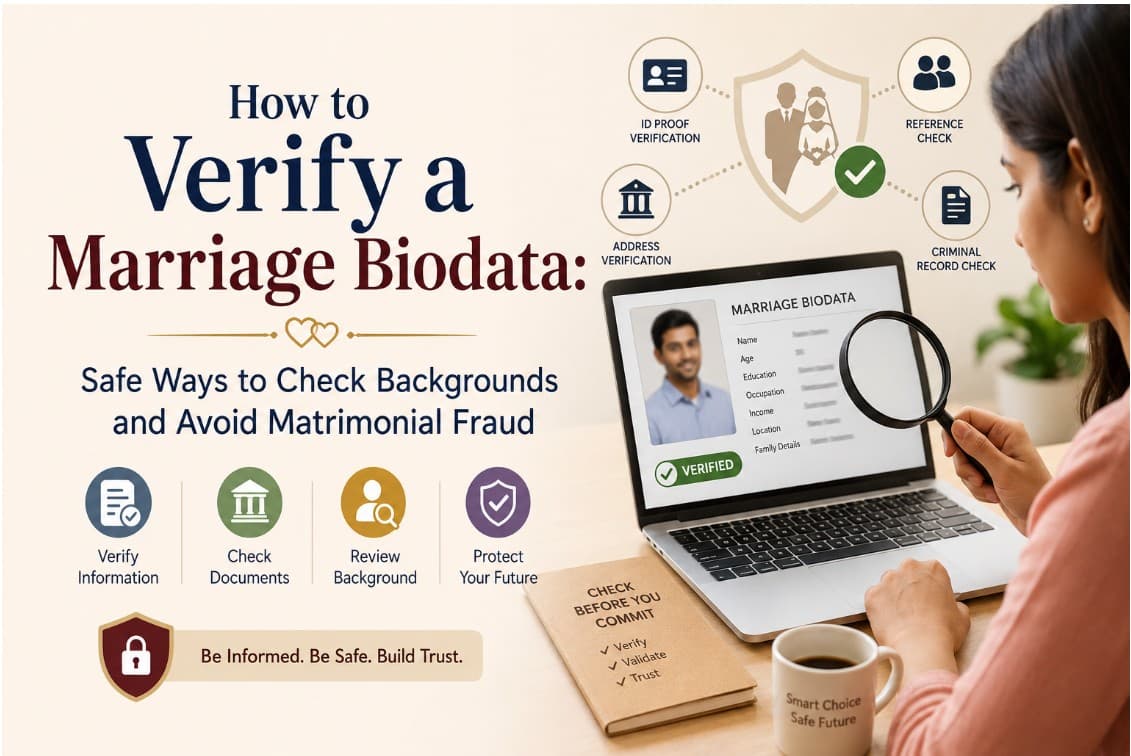
To verify a marriage biodata, you should cross-check key details like education, job, family background, and identity through independent sources such as social media consistency, official company or university records, and basic real-world inquiries. You should also look for mismatches between what is written and what can be logically or publicly confirmed before moving ahead.
A marriage biodata is usually the first structured introduction between two families, but it is still self-declared information. It may look complete and confident, yet it does not automatically guarantee accuracy.
That is why verification matters. It is not about suspicion, but about making sure you are not relying on incomplete or exaggerated information. In modern matchmaking, even genuine profiles can have gaps that need clarification before decisions are made.
Why Marriage Biodata Verification is Important
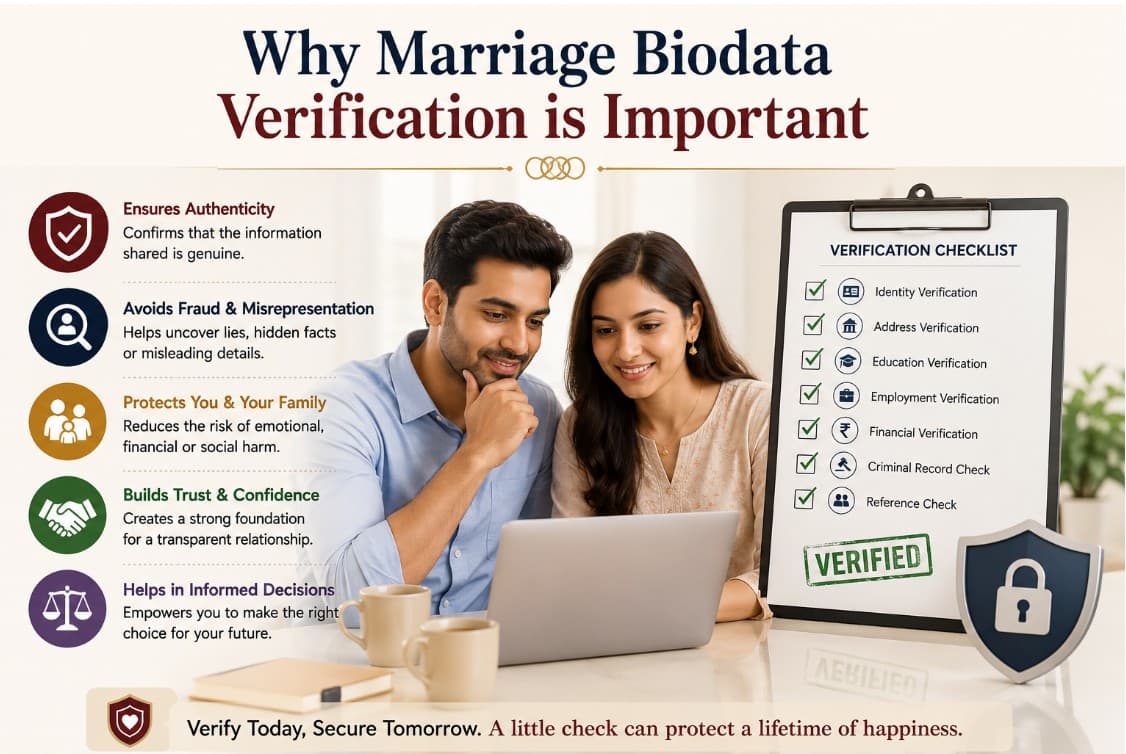
When you evaluate a potential match, you are not just choosing a partner — you are indirectly connecting two families, financial responsibilities, and life decisions. If even one major detail in the biodata is false, it can affect your entire future.
The reality is simple. A well-designed biodata can hide financial instability, false employment claims, previous relationships, or legal complications. These are not rare cases anymore; they are becoming increasingly sophisticated and harder to detect at first glance.
Think of it this way. A biodata is an introduction, not a guarantee. Verification ensures that what is written actually matches reality.
Families who understand this step do not see it as mistrust. They see it as a responsibility.
Common Red Flags in Matrimonial Profiles
Before you even begin deep verification, your first layer of protection is observation. Many fraudulent or misleading profiles reveal subtle inconsistencies early on.
Here are some warning signs you should never ignore:
- The job description is overly vague, such as "business," "consultant," or "self-employed," without a company name or clear explanation.
- They readily send screenshots of offer letters, salary slips, or visas over chat, but the text alignment or fonts look slightly blurry, uneven, or edited. Genuine professionals will show live proof or official email verification, not sketchy screenshots.
- The person insists on moving the conversation away from official matrimonial platforms to other platforms like WhatsApp immediately.
- There is resistance or discomfort when you ask simple background questions about education, workplace, or hometown.
- Video calls are repeatedly avoided under technical or personal excuses.
- There is emotional pressure or urgency to finalise things quickly without proper family interaction.
A key point you should remember is this: genuine families rarely feel threatened by reasonable questions. Over-defensiveness is often more telling than the biodata itself.
Basic Steps to Check Personal Information
Once initial trust is established, you can begin simple but effective verification steps. These do not require professional tools, only attention to detail and consistency checking.
Start with the digital footprint. Most people leave traces online, even unintentionally.
Practical verification actions you can take:
- Search the phone number on caller identification apps to see if it is linked to inconsistent names or spam reports.
- Review social media profiles across platforms like Instagram, Facebook, or LinkedIn and compare timeline consistency.
- Run a reverse image search on profile photos to check whether the images are original or taken from the internet.
- Check mutual connections or community overlap that confirms real-world existence.
A useful mindset here is not to look for "proof of truth" but for "consistency of identity." Fake profiles usually fail when details are cross-checked across platforms.
How to Verify Education and Job Details
Education and employment details are the most commonly misrepresented parts of a marriage biodata. Fortunately, they are also among the easiest to verify if you know where to look.
You are not trying to invade privacy. You are simply confirming claims that directly affect financial stability and lifestyle compatibility.
Reliable ways to verify professional background:
| Area | What You Should Check | Where to Verify |
|---|---|---|
| Education | Degree authenticity, graduation year | University websites, alumni lists |
| Employment | Company existence, job role | Official company website, LinkedIn, MCA registry (India) |
| Career History | Job continuity and timeline | LinkedIn consistency, professional references |
LinkedIn can be useful, but you should not rely on it alone. A real professional profile usually has meaningful connections, endorsements, and colleagues who also appear legitimate.
For companies, official government registries like the Ministry of Corporate Affairs (MCA) in India help confirm whether a business actually exists. Many fake profiles collapse at this stage of verification.
Modern Identity Theft: Religion, Caste, and Status Scams
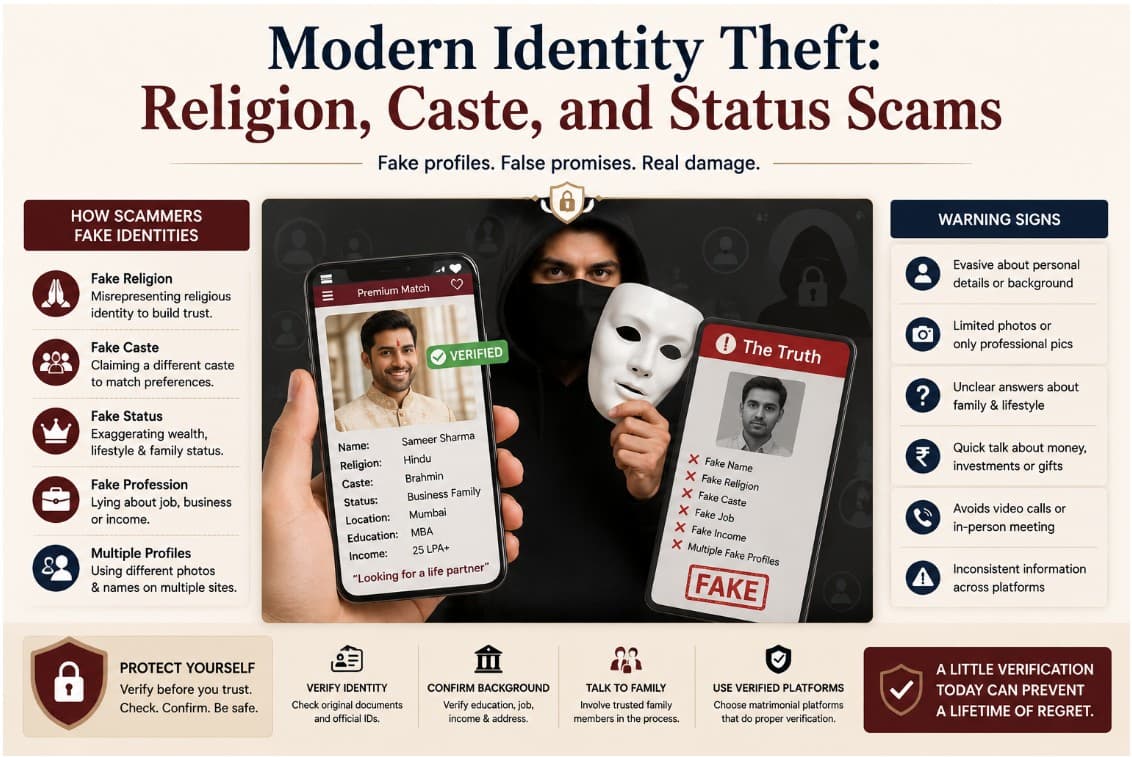
Matrimonial fraud has evolved past basic financial theft. Today, many bad actors engage in deep identity misrepresentation to gain family acceptance or target specific communities. This type of deception often targets highly personal areas of life.
1. Religion and Caste Changing Fraud
To bypass family preferences and gain access to specific social circles, some individuals create completely fabricated backgrounds.
- How it happens: They memorise community-specific rituals, create fake family trees, and temporarily adopt surnames or dialects that match your search filters.
- The Check: Never rely entirely on verbal claims about ancestry. Cross-reference their family details with older, established members of the community, local neighbourhood associations, or ancestral town records.
At BiodataPlus, you create safe biodata for your community.
2. Marital Status Fraud (The "Unmarried" vs. "Divorced" Lie)
Hiding a past marriage, a pending divorce case, or even a living spouse is one of the most common forms of matrimonial deception.
- The "Never Married" Scam: A fraudster may claim to be completely single while maintaining a hidden family in another city or country.
- The "Widow" or "Divorcee" Trap: Conversely, scammers sometimes falsely claim to be a tragic widow or an innocent divorcee to gain immediate emotional sympathy, explain away a lack of family involvement, and accelerate the marriage timeline before their real past catches up to them.
- The Check: Request to view official civil registry documents, or look up their name in public court dockets and litigation databases to check for undisclosed divorce filings or family disputes.
3. Hidden Health Issues and Injury Lies
Deception regarding physical health, chronic illnesses, mental health conditions, or past severe injuries can permanently alter the dynamic of a marriage if discovered after the fact.
- The Medical Cover-Up: Individuals may actively conceal life-altering health dependencies, progressive disorders, or past traumatic accidents that impact long-term compatibility.
- The "Emergency Injury" Pity Play: A match might claim they were suddenly involved in a severe accident or require urgent surgery right before an in-person meeting. This is almost always an emotional manipulation tactic designed to either explain why they cannot meet or to set up a fraudulent request for urgent financial help.
- The Check: Normalise exchanging recent, comprehensive health check-up reports from certified medical centres before final commitments are made. A genuine partner who values a transparent future will understand and participate in this mutual exchange without taking offence.
Here is a guide on what health information to include in your biodata.
Simple Ways to Confirm Family Background
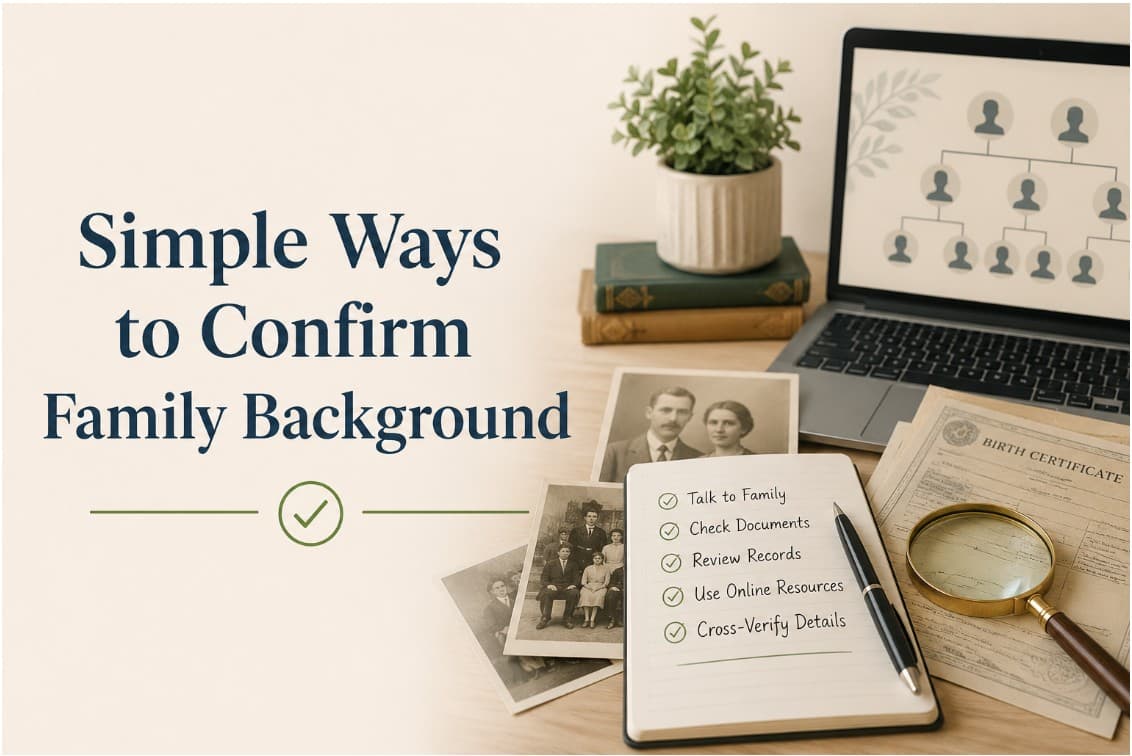
Family background plays a major role in marriage compatibility, especially in traditional setups. This does not mean you should conduct intrusive investigations, but basic confirmation is both reasonable and widely practised.
You can begin with indirect, respectful checks that focus on authenticity rather than judgment.
- Speak casually with local contacts near the mentioned residential area to confirm family presence and reputation.
- If possible, have a trusted family friend visit the neighbourhood to verify address authenticity.
- Observe whether the family is known in community circles, such as religious groups or local associations.
- Cross-check consistency between stated lifestyle and actual surroundings during in-person visits.
The goal here is not to evaluate social status but to confirm that the family details are real and not fabricated.
If a Match Comes Through a Middleman or Known Contacts
Sometimes a marriage proposal doesn't come through a portal but through a middleman, relative, or someone you already trust. In such cases, you might feel an added sense of safety, but that can also reduce your level of scrutiny — which is exactly where mistakes happen.
Even when someone is "known," you should still verify the actual individual independently. Personal connections may be genuine, but they are not proof that every detail shared about the other family is accurate or complete.
- Politely separate the recommender's trust from the actual verification of the biodata. Treat them as two different steps.
- Ask for direct interaction with the person and their immediate family, not just mediated conversations through the middleman.
- Cross-check basic details like workplace, education, and address just as you would in any other proposal.
- If a relative is involved, ensure there is no pressure to skip verification steps for the sake of reputation or urgency.
The key idea is simple: trust the relationship that brought the proposal, but verify the information independently. Even well-meaning intermediaries can unintentionally pass on incomplete or outdated details.
Safe Tips to Avoid Matrimonial Fraud
Fraud in matrimonial contexts is rarely sudden. It usually builds through emotional connection, trust, and gradual manipulation. That is why boundaries are essential from the beginning.
One of the most important rules you should follow is simple: never send money before marriage under any circumstances. Legitimate families will never request financial help from a potential match during early interactions.
You should also be cautious of emotional urgency tactics, such as emergency medical situations or travel crises that conveniently involve financial requests. These patterns are commonly used to bypass rational thinking.
Another important safeguard is meeting in controlled environments. Initial meetings should always happen in public places with family awareness, not in private or isolated settings.
Finally, trust your sense of consistency. If details keep changing slightly over time, that inconsistency itself is a warning.
Final Checklist Before Proceeding with a Match
Before you move forward with engagement or marriage discussions, it helps to go through a structured final check. This prevents emotional decisions from overriding practical caution.
- Have you met the person and their family multiple times in person?
- Have you independently confirmed their job and workplace?
- Does their education history match verified sources?
- Have you checked for consistency in digital presence and identity?
- Have both families interacted in a transparent, open environment?
- Are there any unresolved doubts you are ignoring due to pressure or emotion?
If even two or three answers feel uncertain, it is worth pausing before proceeding. Marriage is a long-term commitment, and clarity is always better than speed.
Start with Transparency Using BiodataPlus

Most matrimonial fraud succeeds because of one vulnerability: unstructured information. Fraudsters hide behind vague paragraphs sent over chat apps, where missing years of employment or hidden background details can easily go unnoticed.
That is exactly why we built BiodataPlus. Our platform forces clarity by organising details into clean, professionally structured digital profiles. Supporting all religions, castes, genders, and unique situations (like remarriages), BiodataPlus leaves no room for vague claims. When a profile is structured, inconsistency stands out immediately — making your matchmaking journey safer from day one.
Closing Thought
Verifying a marriage biodata is not about creating distance between families. It is about ensuring that the connection you build is based on truth, not assumptions. A careful approach today protects you from emotional and financial complications tomorrow.
When you combine thoughtful verification with a structured starting point like BiodataPlus, you are not just finding a match — you are building a safer and more transparent journey toward marriage.