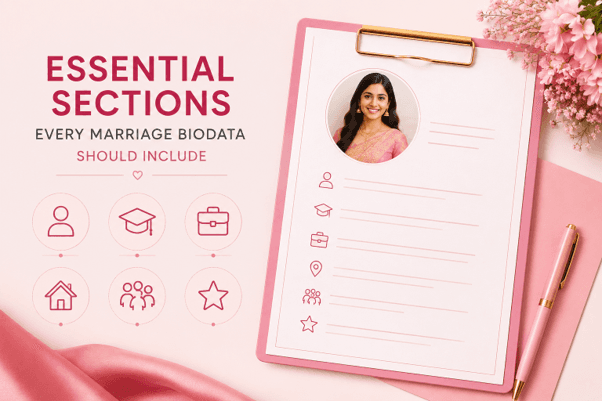
If you've never made a marriage biodata before, you're in the right place. A marriage biodata is a one-to-two-page document that introduces you — your background, family, and personality — to a prospective match's family before any meeting is arranged. Think of it as a resume, but for marriage: less about your CV, more about who you are as a person.
This guide is written for first-timers. It explains what each section is for, what to actually write in it, and the mistakes that most people make the first time around. By the end, you'll have everything you need to fill yours in — or use BiodataPlus and have a formatted PDF ready in under 5 minutes.
What is a Marriage Biodata?
A marriage biodata (also called a matrimonial biodata, shadi ka biodata, or rishta biodata) is a one-to-two-page document shared between families during the matrimonial process. It serves the same purpose as a resume but for marriage — giving the other family a complete picture of who you are.
It typically includes your photo, personal details, family background, education, occupation, and contact information. In Indian culture, it's the standard way to introduce yourself before a meeting is arranged.
By community, the format may vary slightly:
- Hindu — opens with ॐ or ॥ श्री गणेशाय नमः ॥; includes gotra, manglik status
- Muslim — includes sect, community; sometimes called a Nikah biodata or rishta biodata
- Christian — includes denomination (Catholic, Protestant, Syrian Christian, etc.)
- Marathi — includes kul (कुळ), native village (गाव), and often uses the term lagnacha biodata
- Tamil — includes star (natchathiram), rasi, and is sometimes called a jathagam biodata
- Buddhist — includes denomination (Theravada, Ambedkarite/Navayana) and community
The core structure — personal, career, family, contact, photo — is identical across all communities.
7 Key Sections of a Marriage Biodata
Every strong biodata covers these seven areas:
- Personal Information — Name, date of birth, time and place of birth, height, complexion, religion, caste, gotra, mother tongue, marital status, manglik status
- About Me — A short 3-4 sentence paragraph describing your personality, values, and what you are looking for in a life partner
- Career & Education — Highest qualification, college/university, current role, company name, work location, and annual income range
- Family Details — Father's name and occupation, mother's name and occupation, siblings with marital status, family type (nuclear/joint), native place
- Partner Preferences — Optional but helpful: age range, height, education, and values you are looking for
- Hobbies & Interests — Briefly list 4-8 genuine interests; avoids generic filler
- Contact Details — Contact person name (usually father or brother), their phone number, and optionally email and address
Tips for a Great Biodata
- Use a professional photo — formal attire, neutral background, good lighting. Avoid selfies or group photos.
- Be specific about your occupation — "Software Engineer at TCS, Pune" is better than just "Engineer".
- Don't skip gotra — many families need this for kundli matching.
- Keep income range honest but not too specific — "₹12–20 LPA" is appropriate.
- The About Me section matters — a warm, genuine paragraph creates a better first impression than a list of traits.
- Proofread carefully — spelling mistakes suggest carelessness.
- Update regularly — if you change jobs or location, refresh the biodata.
Common Mistakes to Avoid
- Using an outdated or blurry photo
- Leaving sections blank without explanation
- Writing overly generic "About Me" text that could apply to anyone
- Forgetting to include gotra, manglik status, or mother tongue
- Using a plain Word document — Word files look different on every device and don't preview on WhatsApp; always use a designed PDF template instead
- Skipping community-specific fields (kul/gaon for Marathi biodatas; star/rasi for Tamil biodatas)
The Fastest Way to Create Your Biodata
BiodataPlus is a free online marriage biodata maker — works on mobile and desktop, no app download needed. Fill a guided form, the AI writes your About Me, and a print-ready PDF is ready in under 5 minutes. Share directly on WhatsApp. Every design is free to download with a light biodataplus.in watermark; a watermark-free PDF costs ₹21.
Related Guides
- What to Include in a Marriage Biodata — Checklist — already writing yours? Use this to verify every field is covered
- How to Create an Attractive Marriage Biodata — design, photo, and layout tips
- Marriage Biodata Photo Guide — lighting, outfits, angles, and the 5-minute at-home photo checklist
- Marriage Biodata Word Format vs PDF — Which is Better? — why PDF always wins for WhatsApp sharing
- Mobile se Biodata Kaise Banaye — phone पर बायोडेटा बनाने का तरीका
- Marriage Biodata Format for Boy — groom-specific guide with sample content
- Marriage Biodata Format for Girl/Bride — bride-specific guide with About Me examples
- Browse All 17 Biodata Templates — all free
- Hindu Marriage Biodata — Templates & Format
- Muslim Marriage Biodata — Templates & Format
- Marathi Marriage Biodata — Templates & Format