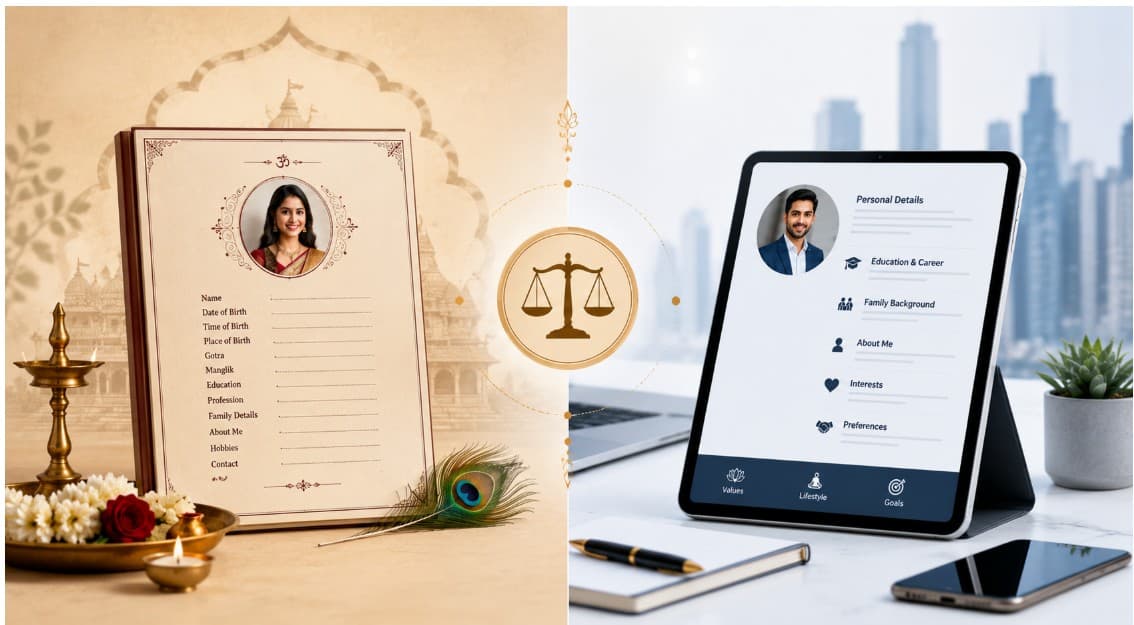
For many Hindu families, kundli matching is not a formality — it is the first real act of due diligence. Before a meeting is arranged, before families speak on the phone, they want to know whether the stars are compatible. And for that check to happen, the biodata needs to have the right information.
A biodata without complete kundli details either gets set aside or generates a follow-up call asking for the missing fields. Neither is the impression you want to make at the very first step.
This guide covers exactly which astrological details belong in a marriage biodata, what each one means, and how to write them correctly — even if you are not particularly religious yourself but your family or the receiving family is.
Why Kundli Details Belong in the Biodata
A marriage biodata is not a legal document — it is an introductory document. Its job is to give the other family enough information to decide whether they want to proceed to a meeting. For Hindu families that practice kundli matching, that decision depends heavily on astrological compatibility.
If the key kundli data is missing from the biodata, one of two things happens:
- The family sets the biodata aside because they cannot do even a preliminary check
- They contact you to ask — which delays everything and signals that you did not think the biodata through
Including kundli details upfront saves time on both sides and signals that you understand the matrimonial process.
The 5 Kundli Details Every Hindu Biodata Needs
1. Time of Birth
This is the most important piece of astrological data. Without it, an accurate kundli cannot be cast.
Write it as: 6:15 AM or 6:15 PM — include AM/PM clearly.
If you genuinely do not know your exact time of birth:
- Check your birth records or hospital documents
- Ask parents or elders — some families note the time in old diaries or almanacs
- If truly unknown, write:
Time of birth: Not known - Do not guess — an incorrect time produces wrong kundli matching results
2. Place of Birth
Required alongside time of birth for accurate kundli casting. The longitude and latitude of your birth city affects planetary positions in the chart.
Write it as: Jaipur, Rajasthan — city and state is sufficient.
3. Manglik Status
This is the detail most families check first. Write it clearly as one of:
Non-ManglikManglikPartial Manglik (Anshik)
What Manglik means: A person is considered Manglik when Mars (Mangal) occupies certain houses in the birth chart — commonly the 1st, 2nd, 4th, 7th, 8th, or 12th house. Different astrological schools consider different houses, which is why you may get different opinions from different astrologers.
If you are unsure: Have your kundli checked by a family astrologer before writing this. Incorrect manglik status causes avoidable misunderstandings later.
Note on Partial Manglik: Anshik (partial) manglik is widely accepted as having a milder effect, and many families are comfortable with partial manglik matches for non-manglik partners. State it accurately — do not write Non-Manglik if you are Anshik Manglik.
4. Gotra
Gotra is a patrilineal lineage identifier. In most Hindu communities, same-gotra marriages are prohibited because gotra is treated as a marker of common ancestry.
Write it as: Kashyap Gotra or Bharadwaj Gotra
If you do not know your gotra: Write To be confirmed and then actually find out. Ask your father, grandfather, or the family pandit. Gotra is not optional — most families will ask before any meeting is arranged.
Common gotras: Kashyap, Bharadwaj, Vashisht, Atri, Vishwamitra, Gautam, Jamadagni, Shandilya, Agastya — among hundreds of others.
5. Rashi and Nakshatra
Rashi (moon sign) and Nakshatra (birth star) are used in compatibility matching — particularly the 36-gun milan (compatibility score) that many Hindu families follow.
Write it as: Mithun Rashi / Punarvasu Nakshatra
These are optional in the biodata — unlike time of birth and manglik status — but including them makes the preliminary matching faster and demonstrates that you are serious about the process.
What NOT to Include in the Biodata
Full janam patrika (horoscope document): The full kundli is a separate, detailed document. It is exchanged privately if both families want to proceed after an initial match — not included in the biodata itself.
Kundli matching scores from previous prospects: Never include this. It is irrelevant to the current family and looks odd.
Astrological predictions or doshas other than manglik: The biodata is not the place for detailed dosh analysis. Keep it to the five data points above.
How to Write the Kundli Section in Your Biodata
The kundli details should be part of the Personal Details section — not a separate section. Here is what it looks like in a well-formatted biodata:
| Detail | Your Entry |
|---|---|
| Date of Birth | 14 September 1994 |
| Time of Birth | 9:45 AM |
| Place of Birth | Lucknow, Uttar Pradesh |
| Rashi / Nakshatra | Mithun Rashi / Punarvasu Nakshatra |
| Gotra | Kashyap Gotra |
| Manglik Status | Non-Manglik |
All six fields in one clean block. Families find it immediately, there is no ambiguity, and the preliminary kundli check can happen without a follow-up call.
For Non-Hindu Families
If you are Muslim, Christian, Sikh, or Jain and do not practice kundli matching, these fields are not relevant to your biodata. Omit them entirely — including blank fields for them signals that the template was not thought through.
Sikh families may include gotra (or family lineage / ancestral village) for compatibility purposes. Jain families may include native place and community lineage. Neither practice involves kundli matching in the Hindu sense.
The Single Biggest Kundli Mistake
Leaving manglik status blank.
Families will not overlook this — they will ask. And asking about manglik status after a first impression has been made creates an awkward exchange that could have been avoided entirely.
If you genuinely do not know your manglik status, get it checked before you share the biodata. A basic kundli check by any astrologer takes 10 minutes and costs nothing at most local temples.
Related Guides
- What to Include in a Marriage Biodata — Complete Checklist — every section explained
- How to Write a Marriage Biodata — full guide for first-timers
- Marriage Biodata Format for Boy/Groom — groom-specific section guide
- Marriage Biodata Format for Girl/Bride — bride-specific section guide
- Classic+ Template — Ganesha Invocation, Traditional Design — the most popular template for Hindu families
- Hindu Marriage Biodata — Templates & Format