A complete marriage biodata must include: personal details (name, DOB, religion, caste, gotra, height), an About Myself section, career and education, family details (parents and siblings), partner preferences, contact information, and a recent photo. This guide covers every section with field-by-field examples and notes on what to skip.
Already writing yours and just want to verify nothing is missing? Jump straight to the complete checklist at the bottom. If you're starting from scratch and need to understand how to write each section — not just what to include — see the beginner's guide to writing a marriage biodata instead.
Section 1 — Personal Details (Essential)
This is the core of your biodata. Every field here is expected by the reader.
| Field | What to Write | Example |
|---|---|---|
| Full Name | Legal name as on documents | Rahul Suresh Sharma |
| Date of Birth | Day Month Year — no abbreviations | 14 September 1994 |
| Time of Birth | Needed for kundli matching | 9:45 AM |
| Place of Birth | City + State | Lucknow, Uttar Pradesh |
| Religion | Full word, not abbreviated | Hindu |
| Caste | Sub-caste if relevant | Brahmin (Kanyakubja) |
| Gotra | Ask elders if unsure | Kashyap Gotra |
| Mother Tongue | Language spoken at home | Hindi |
| Height | Feet and inches | 5 feet 11 inches |
| Complexion | Honest, simple descriptor | Fair / Wheatish / Dusky |
| Marital Status | Never assume it's obvious | Never Married |
| Manglik Status | State clearly — families need to know | Non-Manglik |
| Dietary Preference | Helps families judge compatibility | Vegetarian |
| Blood Group | Optional but good to include | B+ |
On height: Write your actual height in feet and inches. Do not round up. The most common mistake is adding one or two inches — which becomes immediately apparent at the first meeting and creates an awkward start. Families who have a strict height requirement will not be satisfied by marginal rounding; families who are the right fit will not be deterred by your honest height.
On complexion: Use one of the three standard descriptors — Fair, Wheatish, or Dusky — and be honest about which applies. Avoid invented workarounds like "medium fair" or "slightly wheatish" that try to soften the descriptor without changing it. Families meet you at the first meeting and will see for themselves. What they remember from a misrepresented biodata is not your complexion — it is that you were not straightforward. If you are uncomfortable including complexion at all, you may omit it; "Not mentioned" is read less negatively than an obviously embellished descriptor.
On weight: Weight is not a standard field in Indian marriage biodatas and you are not expected to include it. If a family specifically asks, you may share it directly in conversation. Do not include it on the biodata unless your community's specific format requires it.
On gotra: If you genuinely don't know your gotra, write "To be confirmed" rather than leaving it blank. Then go find out — it matters in Hindu matchmaking.
Community-specific fields to add:
- Marathi families — add kul (कुळ) and native village/gaon alongside gotra; the format is locally called lagnacha biodata
- Tamil families — add star (natchathiram) and rasi; essential for horoscope matching; sometimes called a jathagam biodata
- Muslim families — add sect (Sunni/Shia) and community; sometimes called a Nikah biodata or rishta biodata
- Christian families — add denomination (Catholic, Protestant, Syrian Christian, etc.)
- Buddhist families — add denomination (Theravada, Ambedkarite/Navayana) and community
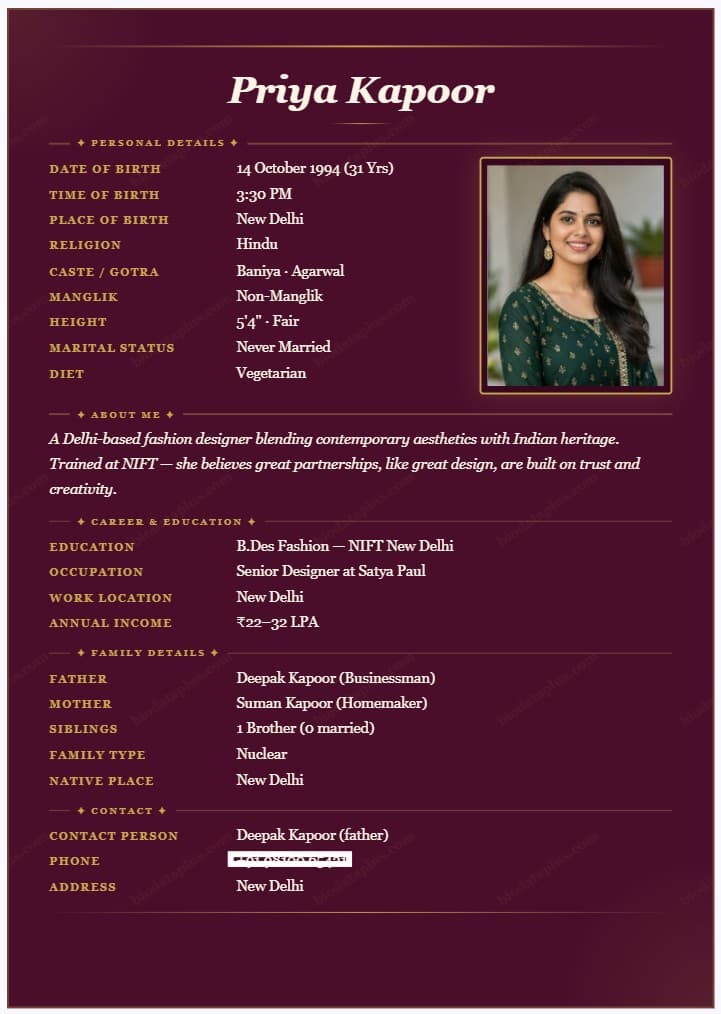
Section 2 — About Me (High Impact)
Most people either skip this or write something generic. Both are mistakes.
The About Me is your only chance to speak in your own voice before the family has met you. It should answer three things in 3–5 sentences:
- Who are you as a person (not just your resume)?
- What does your daily life look like?
- What kind of partner and life are you hoping for?
Weak (do not write this): "I am a simple, homely, and family-oriented person who respects elders and loves spending time with family."
This describes 90% of biodata profiles. It tells the reader nothing.
Strong (aim for something like this): "I work as a civil engineer on infrastructure projects across Maharashtra and genuinely love what I do — there's something satisfying about building things that last. Outside work, I cook on weekends, follow cricket with unhealthy dedication, and have a small but loud extended family in Nashik who gather every Diwali without fail. I'm looking for someone who is curious, has her own ambitions, and is ready to build something together — both literally and figuratively."
This is specific. It's warm. It gives a real picture of a real person.
Section 3 — Career & Education
Families scrutinise this section carefully. Be accurate — misstating qualifications or designations will come out eventually.
- Highest Qualification: Full degree name + college + year — "B.Com (Hons) — Delhi University, 2016"
- Additional Certifications: CA / ICAI / PMP etc. — include if relevant
- Current Designation: Exact job title — "Deputy Manager, Operations" not "Manager"
- Employer: Company name + city — "HDFC Bank, Mumbai"
- Industry: Useful context for families unfamiliar with corporate titles
- Annual Income: Use a range — "₹12–18 LPA". For government employees: grade pay / designation is standard
- Work Location: Current posting city — families factor this into logistics
On income: Do not leave this blank. "Handsome package" or "as per industry standard" are red flags. A range is professional and expected.
Section 4 — Family Details
This section gets read very carefully. Families are assessing not just you but the family their child will marry into.
Parents:
- Father: Full name · Occupation (current or retired) · Organisation (if notable)
- Mother: Full name · Occupation (homemaker, working, retired)
Siblings: For each sibling, one line: name, elder/younger, occupation, married/unmarried.
Example:
- Elder sister: Priya — Doctor (AIIMS Delhi) · Married
- Younger brother: Aakash — CA · Unmarried
Family type: Joint family / Nuclear family / Joint but independent
Native place: Original hometown or ancestral village — "Native: Varanasi, UP"
Financial status (optional): "Settled upper-middle-class family" or "Business family" is acceptable — don't overstate.
What not to include: Medical history, debt, property disputes, or anything that sounds like a disclaimer.
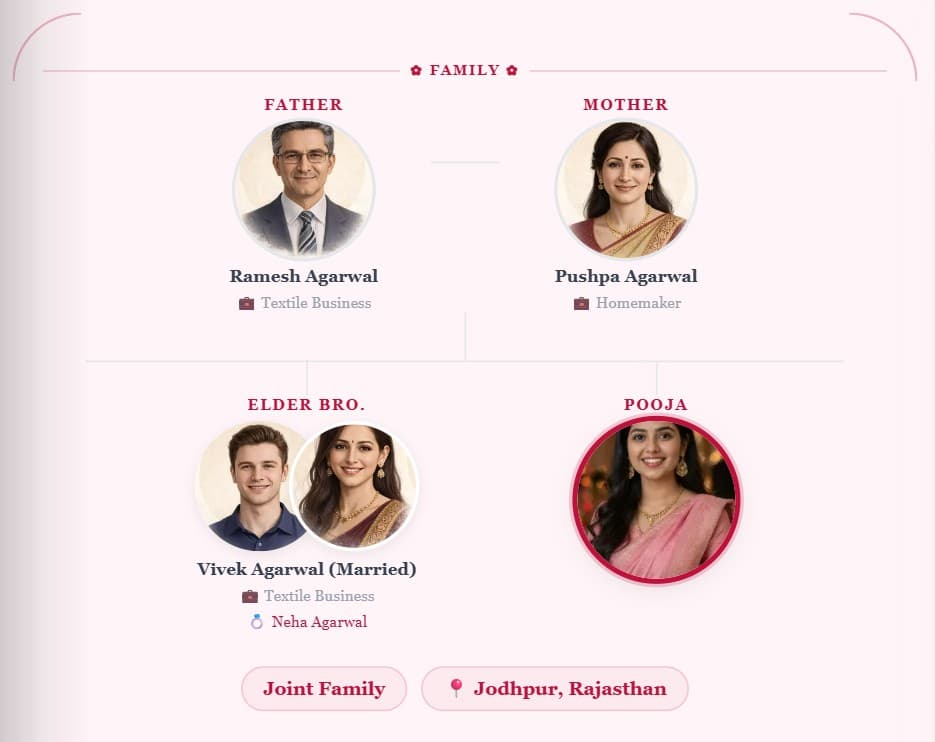
Section 5 — Hobbies & Interests (Optional but Useful)
Keep this genuine and specific. Four to eight items is the right length.
Bad: "Reading, travelling, music" — everyone writes this.
Good: "Badminton (district-level) · Baking sourdough · Bollywood films from the 70s · Amateur astrophotography"
Specific interests give the other family something to talk about at first meeting. They humanise the biodata.
Section 6 — Partner Preferences (Optional)
Some biodatas include this; many don't. If you include it, keep it brief and reasonable.
- Age range: "24–28 years"
- Education: "Graduate or above"
- Location: "Open to relocation"
Avoid: Long lists of requirements, height specifications below a certain threshold, or anything that reads like a job description. Overly specific preferences come across as difficult.
Section 7 — Contact Information
- Contact Person: Usually father, mother, or an elder sibling — never just "family"
- Phone Number: Include country code (+91) for international sharing — WhatsApp-enabled preferred
- Email: Optional but useful for document exchange
- City: Current residence city is enough — no need for full address in the biodata itself
Photo — The Most Important Element
Your photo gets looked at before anything is read. A bad photo cannot be rescued by good content.
Must-haves:
- Taken within the last 6 months
- Formal or semi-formal clothing — kurta, suit, saree, or salwar
- Plain background — white, cream, or grey
- Clear face, no shadows, good lighting
- Portrait orientation (taller than wide)
Must-avoid:
- Selfies or mirror photos
- Group shots or cropped couple photos
- Sunglasses, caps, heavy filters
- Overly casual clothing (gym wear, swimwear, party wear)
- Photos that are clearly old (you look significantly younger)
Read Also — The Marriage Biodata Photo Guide: Dos, Don'ts, and How to Take the Perfect Picture at Home
The Complete Checklist at a Glance
Personal:
- Full name
- Date of birth (day, month, year)
- Time and place of birth
- Religion, caste, gotra
- Mother tongue
- Height and complexion
- Marital status
- Manglik status
- Diet (vegetarian/non-vegetarian)
- Blood group (optional)
Professional:
- Highest qualification (degree + college + year)
- Current designation and company
- Work location
- Annual income (range)
Family:
- Father: name + occupation
- Mother: name + occupation
- Each sibling: name + elder/younger + occupation + marital status
- Family type (joint/nuclear)
- Native place
Other:
- About Me paragraph (3–5 sentences, specific and genuine)
- Hobbies (4–8 specific items)
- Partner preferences (optional, brief)
- Contact person name + phone number
Photo:
- Recent (within 6 months)
- Formal clothing
- Plain background
- Portrait orientation
- No filters or cropping
Ready to Build Yours?
BiodataPlus is a free online biodata maker that walks you through each of these sections step by step — so nothing gets missed. The guided form prompts you for everything on this checklist, the AI writes your About Me, and the result is a polished, print-ready PDF you can download or share on WhatsApp in minutes. Every design is free to download with a light biodataplus.in watermark; a watermark-free PDF costs ₹21. Works on mobile — no app download needed.
Related Guides
- How to Write a Marriage Biodata — First-Timer's Guide — if you're making a biodata for the first time and need a full walkthrough, start here
- How to Create an Attractive Marriage Biodata — design, photo, and layout tips to stand out
- Marriage Biodata Format by Community — Hindu, Muslim, Sikh, Jain and more — community-specific fields explained
- Is It Safe to Share Your Biodata on WhatsApp? — privacy risks and how to protect yourself
- How to Mention Salary in a Marriage Biodata — range vs exact, high earners, business owners
- Marriage Biodata Word Format vs PDF — Which is Better? — why PDF is the right format for WhatsApp sharing
- Marriage Biodata Format for Boy/Groom — section-by-section guide for grooms
- Marriage Biodata Format for Girl/Bride — section-by-section guide for brides
- Marathi Lagna Biodata · Tamil Jathagam Biodata · Buddhist Biodata
- Browse All 17 Biodata Templates — Classic (free), Rose, Mauve Gold, Two Column and more