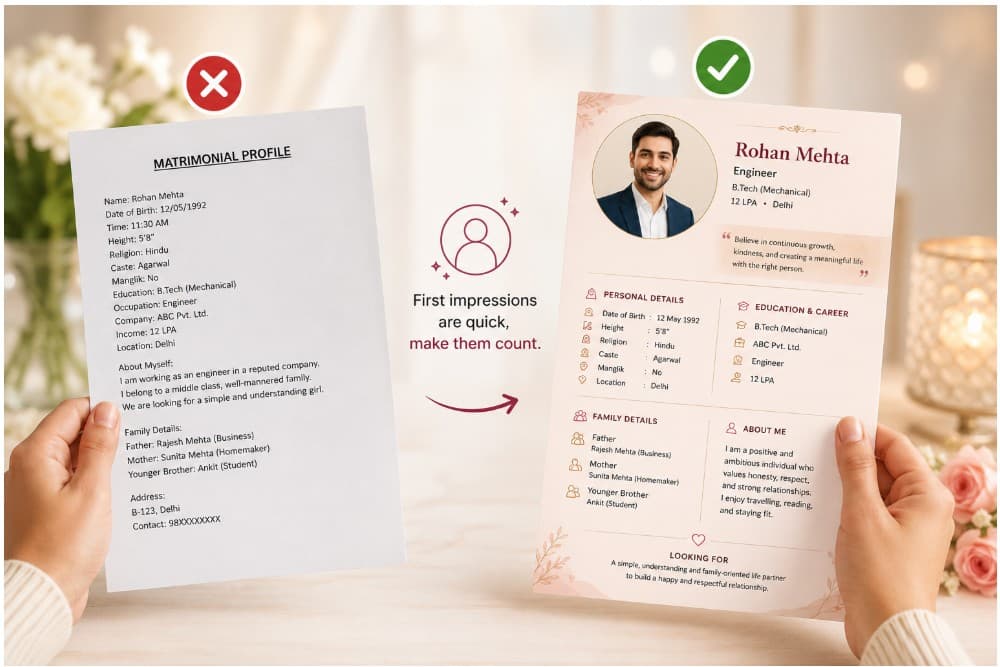
When your family sends out a marriage biodata, there is something important to understand about the family on the other end: they are not reading it the way you wrote it.
They are scanning it. In a matter of seconds, they are making a first pass — deciding whether this biodata earns a closer look, or gets set aside without comment.
Understanding how the receiving family reads your biodata is not a cynical exercise. It is the most practical thing you can do before sending yours. Because if the right things are missing, or in the wrong order, a genuinely excellent candidate never gets a second glance.
Why the First 10 Seconds Decide Everything
A family that is actively searching for a match receives many biodatas. Each one represents someone's child, someone's hope. But the reality is that they cannot give every profile the same attention. The first pass is a filter — rapid, pragmatic, and largely unconscious.
The sequence that follows is not a rule anyone wrote down. It is what research into Indian matrimonial behaviour and community networks consistently shows to be the natural reading order, across regions and communities.
The 10-Second Evaluation Sequence
1–3 Seconds: Community and Structural Compatibility
The first thing a receiving family checks varies significantly by background — and it is worth being honest about this, because India is not one audience.
For traditional and semi-urban Hindu families, caste and sub-caste compatibility is often the very first filter. Not because the family is uninterested in the person, but because a fundamental mismatch here means the proposal cannot move forward regardless of everything else. Manglik status is checked in the same breath — an unresolved mismatch is a quiet deal-breaker for families where it matters.
For modern, urban, and educated families — and this group is growing — caste is either a much softer criterion or not a criterion at all. These families are filtering on something different first: values alignment, profession, family type, city of residence. The biodata still gets scanned rapidly, but what triggers the immediate pass or fail is different.
For Muslim families, the sect (Sunni/Shia) and community are the structural check. For Christian families, denomination. For Marathi families, kul and gaon. Every community has its version of the structural compatibility screen — the specific field that, if it does not match, means the biodata will not proceed to a closer read.
What this means for your biodata:
State your community-specific details clearly and prominently, whatever they are. A family that is compatible will want to confirm them quickly. A family that is not compatible will move on — and that is the correct outcome. Blank fields in this section do not protect you from rejection; they just create confusion before it.
- For Hindu families: caste, sub-caste, gotra, Manglik status
- For Muslim families: sect, community
- For Christian families: denomination
- For Marathi families: kul (कुळ), native gaon
- For Tamil families: star (natchathiram), rasi
4–6 Seconds: The Photograph
Before most people consciously process the written content, the photo has already made an impression.
This is not superficial. The photograph is a trust signal. A clear, well-lit, formal portrait communicates that the sending family is serious, organised, and has presented their child with dignity and care. A blurry photo, a cropped group shot, or a heavily filtered image communicates the opposite — that the family did not invest the effort a marriage proposal deserves.
The photo is also, for many families, the first moment the candidate becomes a real person rather than a list of statistics. A warm, natural expression — not stiff or forced — creates the emotional opening that makes the rest of the biodata readable.
What this means for your photo:
- Taken within the last 6 months
- Formal or semi-formal clothing — a kurta, saree, suit, or salwar kameez, not casual wear
- Plain background — white, cream, or light grey
- No filters, no sunglasses, no group crops
- Portrait orientation, full face visible, good lighting
- A genuine, calm expression — not a forced smile, not blank
A good photo alone cannot save a weak biodata. But a bad photo can end the evaluation before a single word is read.
7–8 Seconds: Education, Occupation, and Income
Once the structural and visual first impression has passed, the receiving family moves to professional credentials.
For male candidates, the scrutiny here is particularly sharp. Families are assessing stability and earning potential — and they are reading between the lines. "Engineer" without a company name raises questions. "Business" without any context leaves the imagination to fill in the gaps, often unfavourably.
For female candidates, the read is different. Families assess educational pedigree and whether the candidate's career ambitions align with the kind of family life they envision. A woman with a demanding career in another city may raise logistical questions for a family expecting the couple to live nearby.
Common mistakes at this stage:
- Leaving income blank. This is the single most common avoidance behaviour, and it signals evasion rather than privacy. A range — "₹18–24 LPA" — is professional, honest, and reassuring
- Vague designations — "IT professional" or "in business" — without specifics
- Not mentioning work location, which families need to assess practical logistics
9–10 Seconds: Family Background
The final check in the first pass is family structure and social standing.
The receiving family is not just evaluating the candidate. They are evaluating the household their child will enter. Parents' occupations, family type (joint or nuclear), and native place all factor into an assessment of social compatibility — whether the two families will be able to relate to each other, share similar values, and maintain a comfortable relationship.
A family that has built their life around certain values — discipline, education, joint family living — will look for evidence of that in the biodata. If the family section feels sparse or evasive, it creates doubt.
What a "Good Biodata" Feels Like to the Receiving Family
There is something families rarely articulate but almost always feel when they open a well-made biodata: relief.
Relief that they do not have to chase missing information. Relief that the family on the other side took this seriously enough to present themselves with care. Relief that whoever formatted this document understands that a marriage proposal is not a casual introduction.
A professionally formatted, complete, politely written PDF is not just aesthetically pleasing. It is read as a reflection of the sending family's sanskar — their upbringing, their values, their seriousness. In the arranged marriage ecosystem, how the biodata is presented is inseparable from what it says.
Conversely, a messy, incomplete, or oddly demanding biodata (especially one with aggressive partner requirement checklists) signals difficulty. It creates discomfort before a single meeting has happened.
The Ghosting Reality
One more thing worth understanding: if the receiving family is not interested, they will almost certainly not say so directly.
Silence is the default rejection signal in the Indian matrimonial world. A dry reply, an unanswered follow-up, a vague "we'll get back to you" — these are polite noes. Direct refusal is considered confrontational and unnecessarily hurtful.
This means the sending family often waits in genuine uncertainty, unable to know whether a biodata worked or not. It is one of the most emotionally exhausting parts of the process, and it is why every biodata needs to be as strong as possible from the first send — because you may never know why one did not lead anywhere.
What This Means for Your Biodata
The receiving family's evaluation sequence gives you a practical checklist in reverse:
- Caste, gotra, Manglik status — stated clearly, never left blank
- Photo — recent, formal, plain background, portrait orientation
- Income — stated as a range, never blank
- Occupation — specific: designation + company + city
- Family details — complete: parents' names and occupations, siblings, family type, native place
- Overall presentation — a well-formatted PDF that reflects effort and seriousness
Get these right, and your biodata earns the second, careful read — the one where the real evaluation begins.