There is something the arranged marriage process does not tell you explicitly, but every family eventually learns through experience:
A marriage biodata has a shelf life.
Not because the candidate changes. Not because the information becomes untrue. But because India's matrimonial networks are deeply social systems — and in a social system, what people say to each other about a profile shapes how seriously it is received.
Understanding this is not about playing games. It is about approaching one of the most important introductions of your family's life with the care and deliberateness it deserves.
How Biodatas Actually Travel
When a family shares a biodata, it does not move in a straight line. It travels through people.
A father calls his college friend, who mentions it to his cousin, who forwards it to someone in the same community WhatsApp group. A mother tells her sister-in-law, who knows a family in the next building whose son is looking. A trusted community elder — a nana, a respected uncle, a local priest — introduces the profile to two families personally.
In each of these cases, the biodata arrives with something attached to it: the credibility of the person who shared it. When a trusted contact forwards a biodata and says "I know this family personally, they are wonderful people, very grounded" — that endorsement carries more weight than anything written in the document itself.
This is the invisible infrastructure of Indian matchmaking. The biodata is the document. The person who introduces it is the trust signal.
The Sponsor Effect
Families that receive a biodata through a trusted intermediary engage with it differently than families that receive one cold — as an unsolicited PDF in a group, or through a matrimonial portal with no connection.
The intermediary's reputation is on the line. They would not share a biodata unless they genuinely believed in the family. That implicit guarantee changes the entire context of the first read.
This is why targeted sharing through trusted contacts almost always outperforms broad broadcasting — even if the broad approach reaches ten times as many families. Volume without trust produces surface-level interest at best.
The Shelf Life Problem
Here is what happens when a biodata circulates widely and for a long time without leading to a match.
People talk. Not maliciously, usually — just the way people in close communities do. A well-meaning aunt mentions to a mutual contact that she forwarded the biodata months ago and heard nothing came of it. The mutual contact wonders why. They begin to speculate.
Is there something wrong with the family? Is the candidate difficult? Is there a hidden detail someone is not mentioning?
Most of the time, the answer is simply that the right family has not been found yet. The process takes time. But in a social network, prolonged visibility without outcome can acquire a quiet stigma — one that makes newer inquiries more cautious than they need to be.
This is why experienced families often pause the search deliberately after a round. Not because they have given up — but because they understand that withdrawing the profile for a few months resets the social perception. When they re-enter, they do so fresh.
What "One Great Biodata" Actually Means
When we say one great biodata is better than ten mediocre ones, we mean something specific.
One great biodata is a document that:
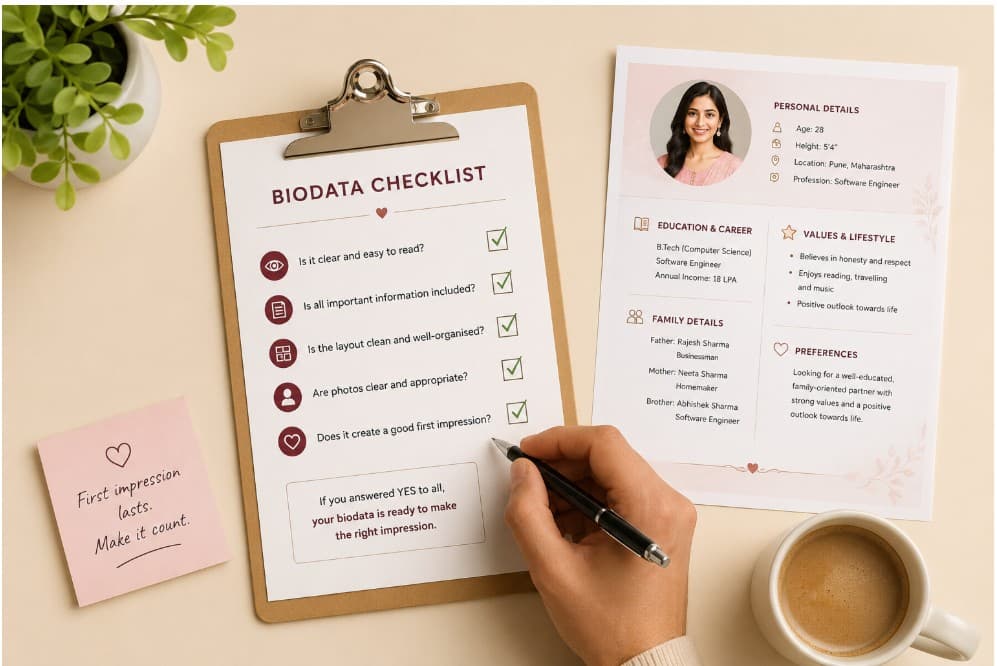
- Presents the candidate with genuine care and dignity
- Is complete — no blank fields, no evasions, no important information left out
- Has a recent, clear, professional photo that becomes real to the receiving family
- Is formatted in a way that signals the sending family's seriousness
- Is introduced through someone who can personally vouch for the family's character
Ten mediocre biodatas are documents sent out quickly, widely, with a photo that was convenient rather than considered, income left blank to avoid the question, and no particular thought given to who is introducing it or why.
The first approach reaches fewer families. It also produces more genuine conversations, because each introduction comes with the weight of a trusted recommendation and the quality to back it up.
The Mother's Calculation
There is a reason experienced mothers in the arranged marriage process are careful about how their child's biodata is shared.
A mother who has been through this process — or who has watched sisters and cousins go through it — understands intuitively what many first-time families discover only in hindsight: the way you introduce your family matters as much as what you introduce.
A biodata shared hastily, through too many channels, without a trusted contact to vouch for it, enters a network as an anonymous document. It competes against dozens of others for a few seconds of attention. Even if the candidate is exceptional, the document may not have the chance to prove it.
A biodata introduced deliberately — through a contact who knows both families, at the right moment, with genuine care in its preparation — arrives with context. It is expected. It is received seriously.
A Practical Approach
If you are beginning the biodata process, or restarting after a pause, here is what the research into how Indian matrimonial networks actually function suggests:
Prepare one excellent biodata. Take the time to get the photo right. Fill every field honestly and completely. Use a format that is professionally presented — one that reflects the care your family has put into raising your child.
Identify two or three trusted contacts who know your family well and who have genuine connections in the community you are looking within. These contacts should be people whose endorsement carries weight — not just people with access to WhatsApp groups.
Share through those contacts first. A small, trusted first round is more valuable than a large, unfocused one. It gives you information — which approaches work, what questions come up — before you expand.
Update before re-entering. If you pause and restart, change something real: a new photo, an updated role, a refreshed template. Give the contacts who are introducing you something genuinely new to say.
What This Changes About How You Use BiodataPlus
The practical implication: when you create your biodata on BiodataPlus, treat it as a single, carefully prepared introduction — not a quick form to fill and forward in bulk.
The guided form, the AI-written About Me, the choice of template — each of these is an opportunity to create something that genuinely represents who your candidate is and what your family values. A biodata that was made with that intent reads differently from one that was assembled in five distracted minutes.
The family on the other side will feel the difference.