A marriage biodata has the same core structure regardless of community: personal details, career and education, family background, contact information, and a photo. What changes from one community to another is a specific set of fields — some mandatory, some optional — that carry meaning within that community's matchmaking process.
This guide covers what is different for each major community, what is universal, and which templates work best for each format.
What Is Universal (Every Community)
Regardless of community, every biodata must include:
- Full name — legal name as on documents
- Date of birth — day, month, year
- Height — in feet and inches
- Education — highest qualification, college, year
- Career — current role, employer, city, income range
- Family details — parents (name + occupation), siblings (name + elder/younger + occupation + marital status)
- Contact — contact person (usually a parent or sibling) + phone number
- Photo — recent, formal, plain background
Everything else — the invocation, gotra, star, sect, kul — is community-specific.
Hindu Marriage Biodata
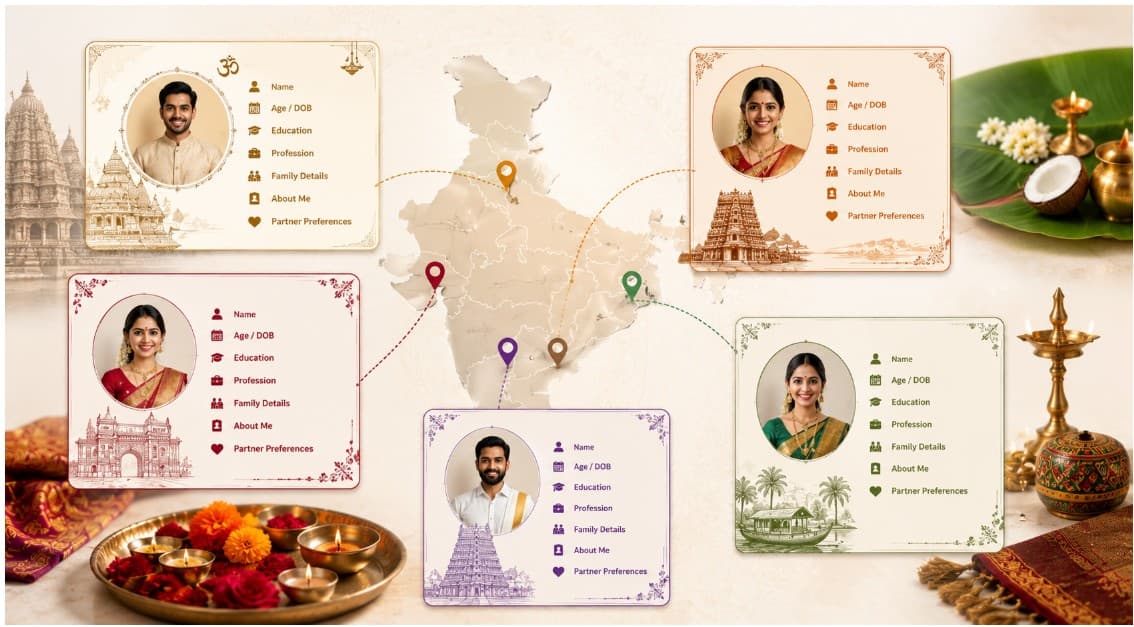
The most structurally detailed biodata format. Hindu matchmaking has the most community-specific fields.
Community-specific fields:
| Field | What to Write | Notes |
|---|---|---|
| Opening invocation | ॥ श्री गणेशाय नमः ॥ or ॐ | Placed at the very top; signals community |
| Gotra | Your paternal gotra (e.g. Kashyap, Bharadwaj) | Required for sagotra verification — ask elders if unsure |
| Manglik status | Non-Manglik / Manglik / Partial Manglik (Anshik) | Critical for horoscope matching; always include |
| Time of birth | HH:MM AM/PM | Needed for kundli matching |
| Place of birth | City + State | Needed for kundli matching |
| Nakshatra / Rashi | Your birth star and moon sign | Optional but helpful for families who check before requesting full horoscope |
| Native place | Ancestral town/village | Expected in most Hindu communities |
Sub-community variations:
- Brahmin — gotra is a primary identity marker; some families also list the shakha (Vedic branch)
- Rajput — clan (vansh) is often listed alongside gotra
- Bania/Vaishya — native place and business background carry extra weight
Create a Hindu marriage biodata →
Muslim Marriage Biodata (Nikah Biodata / Rishta Biodata)
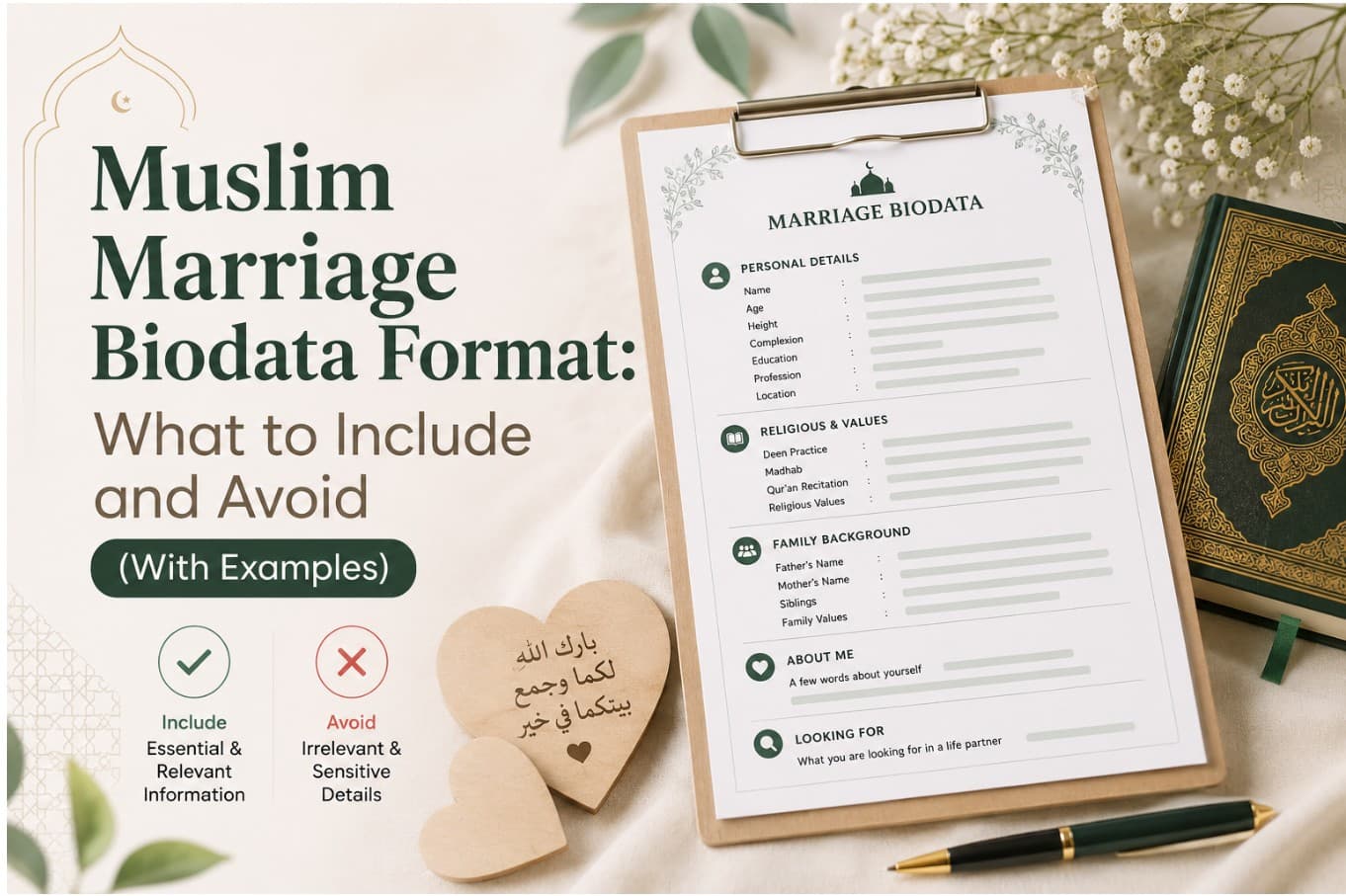
Sometimes called a Nikah biodata, rishta biodata, or matrimonial biodata. The opening invocation changes; gotra and Manglik status do not apply.
Community-specific fields:
| Field | What to Write | Notes |
|---|---|---|
| Opening | Bismillah ir-Rahman ir-Rahim | Replaces Hindu invocation |
| Sect | Sunni / Shia / Ahmadiyya / other | Include clearly |
| Community / Caste | Syed, Shaikh, Pathan, Ansari, Qureshi, etc. | Relevant for community matching |
| Dietary | Halal preferred | Standard; usually assumed |
Gotra, manglik status, time of birth (for kundli purposes), and nakshatra do not apply and should not be included.
Create a Muslim marriage biodata →
Sikh Marriage Biodata
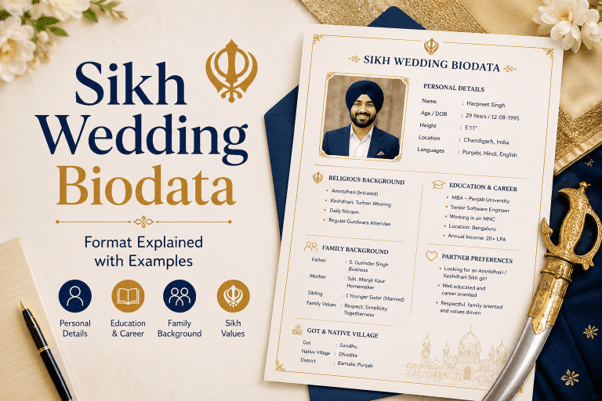
A Sikh biodata is closest in structure to a Hindu biodata, with some distinct fields and some that do not apply.
Community-specific fields:
| Field | What to Write | Notes |
|---|---|---|
| Gotra / family lineage | Paternal gotra or family lineage | Used for verification, though anand karaj does not have the same sagotra restriction as Hindu marriage |
| Native village | Ancestral village in Punjab, Haryana, or elsewhere | Expected in traditional Sikh families |
| Amritdhari | Yes / No | Whether the candidate is Amrit-initiated; relevant for religious compatibility |
| Sub-community | Jat, Khatri, Arora, Ramgarhia, etc. | Relevant for some families |
Manglik status does not apply in Sikhism. Kundli matching is not part of Sikh religious tradition (though some families from Hindu-Sikh interfaith backgrounds may ask for it).
Create a Sikh marriage biodata →
Christian Marriage Biodata
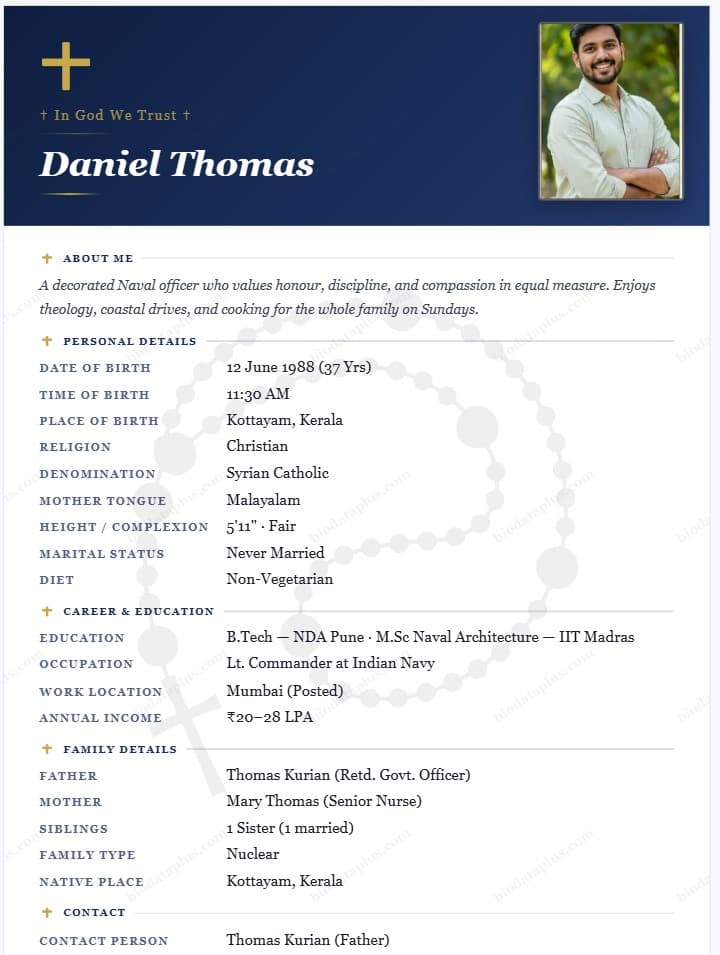
A Christian biodata follows the same core structure. The primary community-specific field is denomination.
Community-specific fields:
| Field | What to Write | Notes |
|---|---|---|
| Denomination | Catholic, Protestant, CSI, CNI, Syrian Christian, Pentecostal, etc. | Specific denomination matters more than just "Christian" for some families |
| Diocese / Parish | Optional | Useful for Catholic families in particular |
| Native place | State + community origin | e.g. "Kerala — Syrian Christian", "Goa — Catholic" |
Gotra, manglik status, and kundli fields do not apply.
Create a Christian marriage biodata →
Jain Marriage Biodata

Jain biodatas are notably distinct in a few fields. Religious practice and dietary strictness are more explicitly stated than in most other communities.
Community-specific fields:
| Field | What to Write | Notes |
|---|---|---|
| Sect | Digambar / Shvetambar | A primary distinction for Jain families |
| Sub-sect | Sthanakwasi, Terapanthi, Bisapanthi, etc. | Relevant in some families |
| Dietary preference | Strict vegetarian | Expected; many families are also no-root-vegetable (no onion, garlic, potato) |
| Native place | City of origin | Business community origins carry weight |
| Religious observances | Paryushana etc. | Optional; relevant for very devout families |
Manglik status is not a Jain tradition. Kundli matching varies — some Jain families do use horoscopes, others do not.
Create a Jain marriage biodata →
Marathi Lagna Biodata
Called lagnacha biodata (लग्नाचा बायोडाटा) in Marathi, this format has two fields that are specific to the Marathi community.
Community-specific fields:
| Field | What to Write | Notes |
|---|---|---|
| Kul (कुळ) | Ancestral clan name | Expected in Marathi Brahmin and other traditional families |
| Native village (गाव) | Ancestral village, often in Maharashtra | Carries social and community meaning |
| Gotra | Paternal gotra | Same as Hindu biodata — required |
| Manglik status | Same as Hindu biodata | Required |
The biodata may open with ॥ श्रीगणेशाय नमः ॥ or the family's kuldevi invocation.
Create a Marathi lagna biodata →
Tamil Marriage Biodata (Jathagam Biodata)
Also called a jathagam biodata in Tamil-speaking families. The astrological fields are distinct and are a primary matching criterion.
Community-specific fields:
| Field | What to Write | Notes |
|---|---|---|
| Star (natchathiram / nakshatra) | e.g. Rohini, Ashwini, Revati | Required for horoscope matching |
| Rasi | e.g. Mesham, Rishabam, Midhunam | Moon sign — required |
| Gotra | Paternal gotra | Required for Brahmin families; also used in other Tamil Hindu communities |
| Manglik status | Same as Hindu biodata | Stated as "Sevvai dosham" in Tamil; include clearly |
| Caste / sub-caste | Brahmin, Mudaliar, Nadar, Gounder, Vellalar, etc. | Relevant for community matching |
| Native district | Chennai, Coimbatore, Madurai, etc. | Expected |
Families will typically request the full horoscope (jathagam) before a meeting is arranged — the star and rasi on the biodata are the initial filter.
Create a Tamil marriage biodata →
Choosing the Right Template by Community
The design of your biodata should feel appropriate for your community and the families you are reaching:
- Hindu (traditional) — Classic+ or Rose+ with Ganesha invocation; warm brown, gold, or rose tones
- Hindu (modern urban) — Modern, Two Column, or Royal Blue; clean and professional
- Muslim — Muslim Green, Sage Green, or Plain White; dignified and clean
- Sikh — Plain White, Royal Blue, or Indigo; respectful and professional
- Christian — Christian Navy, Modern, or Sage Green; elegant and understated
- Jain — Plain White or Sage Green; clean, minimal, appropriate for a strict-vegetarian community
- Marathi — Classic, Vermilion, or Mauve Gold; traditional palette with warmth
- Tamil — Plain White, Modern, or Teal Copper; works across all Tamil communities