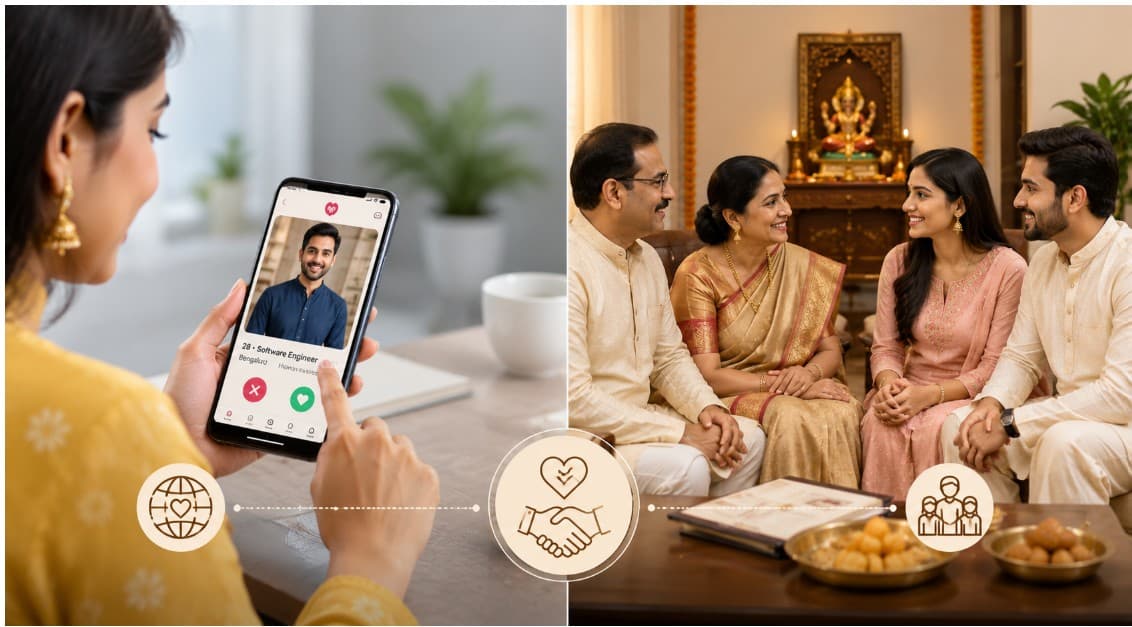
India has 10 million weddings a year, the world's lowest divorce rate, and a generation increasingly questioning whether marriage is for them. Here is what the data shows — ordered from the most rigorously sourced to the most recent survey evidence.
Top 5 Marriage Stats: India
- India holds approximately 10 million weddings per year — 30,000 every day.
- Women with a college education marry, on average, 5.7 years later than women with no formal schooling.
- India's divorce rate is 0.01 per 1,000 people — the lowest recorded rate in the world.
- The matrimonial services industry in India is projected to reach $1.42 billion by 2030.
- According to a 2025 survey, 42% of young Indians above 26 say they do not want to get married.
How Many Marriages Happen in India?
India records approximately 10 million marriages per year — that works out to roughly 30,000 weddings every single day.
To put that in perspective: the entire United States has around 2 million weddings per year. India's daily wedding count exceeds the US's weekly count.
The 2024 peak wedding season alone — a 35-day window between November 12 and December 16 — saw an estimated 4.8 million ceremonies, up from 3.8 million the previous year. CAIT (Confederation of All India Traders) estimates those 4.8 million weddings generated over Rs 6 trillion in spending across catering, venues, jewellery, clothing, and logistics.
India's wedding industry is valued at approximately $130 billion — nearly twice the size of the US wedding market.
Source: CAIT / Business Standard, Weddings in India — Wikipedia
Age at Marriage in India (NFHS-5 Data)
The National Family Health Survey (NFHS-5, 2019–21) is the most comprehensive household survey on marriage patterns in India, covering 6.37 lakh households across all states.
The median age at first marriage for women has been rising steadily for two decades:
| Survey | Women (median) |
|---|---|
| NFHS-3 (2005–06) | 17.2 years |
| NFHS-5 (2019–21) | 19.2 years |
| National mean (2023) | 24.3 years |
The gap between educated and uneducated women is stark:
| Education level | Median age at first marriage |
|---|---|
| No schooling | 17.1 years |
| 1–7 years of schooling | 17.9 years |
| 8–11 years of schooling | 19.7 years |
| 12+ years of schooling | 22.8 years |
Women who complete higher secondary education or above marry 5.7 years later on average than women with no formal schooling.
Source: NFHS-5, UNFPA India Analysis
Child Marriage in India by State
Despite legal prohibition under the Prohibition of Child Marriage Act, child marriage (marriage before age 18 for girls) remains prevalent in several Indian states.
NFHS-5 data shows the percentage of women aged 20–24 who were married before age 18:
| State | Child marriage rate |
|---|---|
| West Bengal | 42% |
| Bihar | 40% |
| Tripura | 39% |
| Andhra Pradesh | 33% |
| Rajasthan | 25% |
| Himachal Pradesh | 5% |
| Kerala | 6% |
| Goa | 7% |
The urban-rural gap is approximately 2 years — women in rural areas continue to marry earlier across all states.
Source: NFHS-5 State Fact Sheets
India vs the World: Marriage Rates
India's crude marriage rate — the number of marriages per 1,000 people per year — sits significantly above the global average for developed economies.
| Country / Region | Crude marriage rate (per 1,000) |
|---|---|
| India | 6.8 |
| United States | ~6.0 (declining) |
| Europe (average, 2023) | 4.0 |
| Europe (peak, 1964) | 8.0 |
Europe's marriage rate has halved over 60 years. India's has remained structurally elevated — driven by near-universal marriage rates (96–98% of Indians marry at some point in their lives) and a younger median population.
Source: Our World in Data — Marriage Rates
India's Divorce Rate — The World's Lowest
India's crude divorce rate is approximately 0.01 per 1,000 people — the lowest recorded rate in the world.
For comparison:
| Country | Divorce rate (per 1,000) |
|---|---|
| India | 0.01 |
| Japan | 1.5 |
| UK | 1.7 |
| Australia | 1.9 |
| USA | 2.3 |
India's rate is 230 times lower than the USA's.
However, researchers are careful about how this number is interpreted. A 2025 academic paper (Reed, Journal of Family Issues) found that middle-class Indians view arranged marriage as a "safer gamble" precisely because family endorsement acts as an informal insurance policy against conflict — not because marriages are inherently more harmonious.
The structural factors that keep India's divorce rate low include social stigma around divorce, legal costs and time (a contested divorce can take 5–10 years), financial dependence (particularly for women in rural areas), and family pressure to resolve conflicts internally.
Source: Rematch — Divorce Rate India Statistics 2024, SAGE Journals 2025
The Spousal Age Gap Is Narrowing
A 2025 arXiv study tracking spousal age gaps across Indian states found the gap between husband and wife has been narrowing over decades.
In Tamil Nadu: the average spousal age gap went from 8.1 years (marriages before 1970) to 6.3 years (post-1990). Similar trends were observed nationally — driven by rising female education, later age at marriage, and urban migration.
The study identified that economic and educational factors predict spousal age gaps more reliably than community or caste.
Source: arXiv 2025 — Marrying Up or Matching Even?
Dating Apps in India
India's dating app market has grown faster than almost any other country.
| Year | Active users |
|---|---|
| 2018 (baseline) | ~20 million (est.) |
| 2023 | 82.4 million |
| 2030 (projected) | — |
That is a 293% increase in five years. The market was valued at $788 million in 2024 and is projected to reach $1.42 billion by 2030 (CAGR ~10.65%).
The fastest-growing user segment is not metropolitan: 70% of new dating app users come from Tier 2 and Tier 3 cities.
Importantly, the matrimonial market is not declining alongside this growth. BharatMatrimony (Matrimony.com) generated Rs 4.72 billion (~$56 million USD) in revenue in FY2024. Many Indians now maintain profiles on both a dating app and a matrimonial platform simultaneously — using apps for initial discovery and matrimonial sites for family-level conversations.
Source: DeveloperBazaar Dating App Statistics 2025, MarkNtel Advisors — India Dating Apps Market, Statista — BharatMatrimony Revenue
Men Delaying Marriage: The Economic Factor
A 2024 Cornell University sociology study titled "Young, Male and Aimless" identified economic stagnation as the primary driver of marriage delay in Indian men — not cultural preference.
Young men with unstable employment or uncertain career trajectories are systematically delaying marriage, particularly in urban areas. This is separate from the female education-driven delay documented in NFHS-5 — two different mechanisms producing the same observable outcome: rising median age at first marriage.
Source: Cornell Sociology 2024
Arranged vs Love Marriage: A Shifting Split
Note: The statistics in this section come from industry surveys rather than government data. Treat them as directional indicators rather than definitive figures.
A 2023 WeddingWire India industry survey found:
| Year | Arranged marriages (%) |
|---|---|
| 2020 | 68% |
| 2023 | 44% |
A 24-percentage-point drop in three years — if the survey methodology holds up, it would represent one of the fastest cultural shifts in Indian matrimonial history.
However, the picture is more nuanced than the headline. A separate analysis found that 85% of Indian marriages still involve family in a meaningful decision-making role — the shift is from fully arranged (family selects) to semi-arranged (individual selects, family approves). The category is changing definition as much as declining in practice.
Source: Outlook Business — Love Marriages on Rise
Gen Z and Marriage: A Generation Reconsidering
The statistics below come from surveys of self-selected samples. They reflect trend signals, not census-level findings.
A March 2025 survey reported that 42% of young Indians above the age of 26 say they do not want to get married. A Statista study found that 23% of Indian Gen Z say they want neither marriage nor children — compared to 19% of millennials.
Bumble's 2024 India report found that only 23% of women on the platform are actively seeking marriage — 72% want long-term relationships without the formal marriage structure. This figure skews significantly toward urban, English-speaking, younger users and should not be read as representative of all Indian women.
What is consistent across multiple data sources: highly educated urban Indian women are delaying marriage, reassessing its necessity, and — increasingly — treating it as one of many options rather than an inevitable milestone.
Source: Medium — 42% of Young Indians Don't Want to Marry, Statista — Gen Z India, Bumble 2024 India
Key Takeaways
- India's marriage market is enormous — 10 million weddings a year, a $130B wedding industry, and a near-universal marriage rate
- The age at first marriage is rising fast, driven primarily by female education
- India's divorce rate is structurally the world's lowest — but low divorce is not the same as high marital satisfaction
- Dating apps have grown 293% since 2018 and are now used across Tier 2/3 cities, not just metros
- The arranged vs love marriage split is shifting — but family involvement in marriage decisions remains the Indian norm
If you are preparing a marriage biodata, BiodataPlus has free templates that take under 5 minutes. Or browse 100 About Me examples to find the right words.