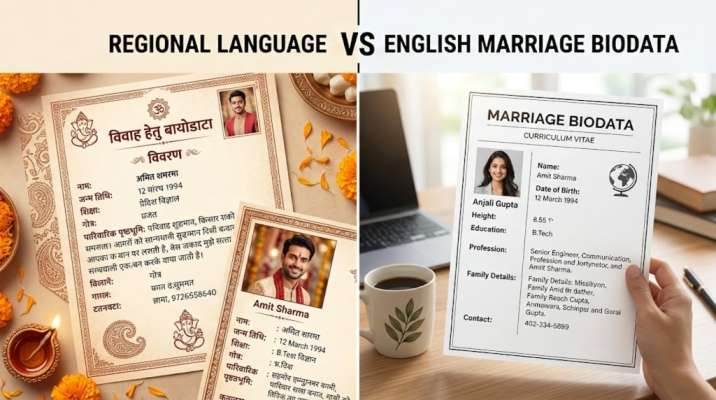
There is no single best language for a marriage biodata. The right choice depends on who will read it first and where you're looking for a match. A regional language biodata works well for traditional family introductions, while an English biodata offers better reach for inter-state, professional, and NRI matches. If your marriage search involves different audiences, keeping both versions is often the most practical option.
Regional Language vs English Marriage Biodata: Side-by-Side Comparison
| Factor | Regional Language | English |
|---|---|---|
| Best audience | Parents, elders, local matchmakers | Young professionals, self-managed searches, NRIs |
| Readability | Comfortable for native speakers | Easy across different states |
| Traditional appeal | Strong cultural connection | Modern and professional appearance |
| Community acceptance | Excellent within the same community | Better for broader matchmaking |
| NRI suitability | Limited if readers cannot read the script | Highly suitable |
| Digital sharing | May require proper font rendering | Works smoothly on almost every device |
| Cultural expression | Preserves traditional terms naturally | May require simplified explanations |
| Horoscope presentation | Native astrology terms are easier | Needs translated terminology |
| Matrimonial websites | Useful for community-focused portals | Widely accepted across platforms |
The differences exist because every audience has different expectations.
Regional languages preserve cultural expressions, family traditions, and religious terminology without needing explanation. Words related to Gotra, Rashi, Nakshatra, or family customs often feel more natural in the local language.
English, however, improves accessibility. Someone from another state, another community, or another country can understand your profile immediately without needing translation. That wider accessibility is one reason English has become increasingly popular among younger professionals.
The Language You Choose Says More Than You Think
Many people assume changing the language of a marriage biodata is simply a matter of translation. In reality, it changes how your profile is perceived.
Your language choice quietly communicates several things before anyone even starts reading your details. It can reflect your family's expectations, your lifestyle, your educational background, and even how comfortable the reader feels with your profile.
For example, the same biodata may receive very different reactions when shared in Hindi and English. Parents may instantly connect with the Hindi version because it feels familiar and respectful of tradition, while a working professional from another state may find the English version easier to understand and evaluate.
Language is not just about words. It influences the reader's confidence, comfort, and willingness to continue the conversation. Create Now!
Before Comparing, Ask Yourself One Simple Question
Instead of asking which language is better, ask yourself something more practical:
Who will read your marriage biodata first?
Your answer often makes the decision much easier.
The first reader could be:
- Your parents or grandparents
- A relative helping with matchmaking
- A community matchmaker
- The prospective bride or groom
- Their parents
- A matrimonial website user
- Someone receiving your biodata on WhatsApp
This is sometimes called the "first-reader filter." In many Indian families, a marriage biodata is first reviewed by elders before it reaches the prospective bride or groom. If those family members are more comfortable reading a regional language, using English alone may unintentionally create distance.
On the other hand, if you are handling your own marriage search through matrimonial platforms or professional networks, English may help your profile reach more people without language becoming a barrier. Explore free templates
When a Regional Language Biodata Creates a Better First Impression
There are situations where a regional language biodata immediately feels more appropriate.
It works particularly well when:
- Your search is focused within the same caste or community.
- Parents are managing most conversations.
- Elder relatives participate in profile screening.
- You are sharing biodatas through local community groups.
- Religious or community organisations are involved in matchmaking.
Parents often appreciate reading important personal information in the language they use every day. It reduces misunderstandings and creates a stronger emotional connection.
Regional language biodatas also preserve traditional terminology without awkward translations. Instead of replacing culturally meaningful words with English equivalents, you present information exactly as families expect to see it.
If your marriage search is primarily community-driven, this familiarity can make a positive first impression.
Why More Young Professionals Prefer English Marriage Biodatas Today
The growing popularity of English marriage biodatas is less about replacing culture and more about improving communication.
English works especially well if you are:
- Working in a metro city
- Looking for inter-state alliances
- Searching for NRI matches
- Managing your own matrimonial profile
- Sharing your biodata through email, WhatsApp, or matrimonial websites
Many professionals today receive profiles directly rather than through relatives. English helps them quickly understand education, career achievements, interests, and future goals without language becoming an obstacle.
A clean English biodata also fits well with modern digital communication. Whether someone opens it on a phone, tablet, or laptop, it is usually easier to read and share across different regions.
Also Read: Canva vs Dedicated Marriage Biodata Maker: Which One Should You Choose in 2026?
The Hidden Problem Most Families Realise Too Late
One challenge many families discover only after starting the marriage search is that a single biodata often cannot satisfy everyone.
Imagine situations like these:
- You are comfortable reading English, but your parents prefer Hindi.
- The bride's family speaks Marathi while the groom's family primarily uses Gujarati.
- An NRI relative helping with the search speaks the language but cannot comfortably read the regional script.
- Your biodata is shared with both traditional relatives and working professionals across multiple cities.
Trying to solve every situation with one document often leads to compromise.
Some people create bilingual PDFs containing both languages together. While that may seem convenient, it frequently makes the document longer, cluttered, and harder to read.
In most cases, two separate, well-designed biodatas provide a much better experience than squeezing two languages into a single file.
Real-Life Scenarios: Which Language Works Best?
The easiest way to decide is by looking at practical situations.
Scenario 1: You are searching within your own community
Recommendation: Regional language
Families already share the same language and cultural expectations, making communication smoother.
Scenario 2: You are a software engineer working in Bengaluru
Recommendation: English
Your matches may come from different states where English is the common language.
Scenario 3: You are looking for an NRI alliance
Recommendation: English
Many second-generation NRIs understand spoken regional languages but may not read regional scripts comfortably.
Scenario 4: Your parents are handling the marriage search
Recommendation: Regional language
It helps them confidently introduce your profile to relatives and community contacts.
Scenario 5: You are searching across multiple states
Recommendation: English
It removes language barriers and increases your potential reach.
Scenario 6: You are using both offline introductions and matrimonial websites
Recommendation: Keep both versions
This gives you flexibility without forcing every reader to adjust to one language.
Why More Families Now Keep Two Marriage Biodatas
Instead of debating which language is superior, many families now prepare two professionally designed biodatas.
One version is created in English for wider digital sharing.
The second version is prepared in the family's preferred regional language for traditional introductions.
This approach offers several advantages:
- Wider reach without sacrificing tradition
- Greater comfort for parents and elders
- Easier sharing across different audiences
- Professional presentation for online platforms
- Better cultural acceptance during family discussions
It also allows you to send the right biodata depending on who receives it first, rather than expecting one document to work equally well for everyone.
Creating Marriage Biodatas in Multiple Languages Doesn't Have to Be Difficult

Creating two separate marriage biodatas manually can quickly become frustrating. Every update means editing both files again, and it's common to face formatting issues, broken fonts, or translation mistakes.
That's where BiodataPlus helps. We make it easy to create professional marriage biodatas in multiple Indian languages without starting from scratch every time.
With BiodataPlus, you can:
- Create marriage biodatas in multiple Indian languages
- Choose from 17 free templates
- Download clean, professional PDF files
- Edit your biodata anytime
- Share mobile-friendly PDFs on WhatsApp and matrimonial websites
Instead of spending time managing multiple files, you can create well-designed biodatas for every audience from one platform.
Also Read: How to Create an Attractive Marriage Biodata That Gets More Responses
Final Thoughts
Choose the language that best suits the people you're sharing your marriage biodata with — not just your own preference. If your search involves different audiences, keeping both an English and a regional language version is often the smartest approach.
With BiodataPlus, you can create professional marriage biodatas in multiple Indian languages using free templates, then download and share them in minutes.
Create your marriage biodata with BiodataPlus today and make the right first impression with every match.