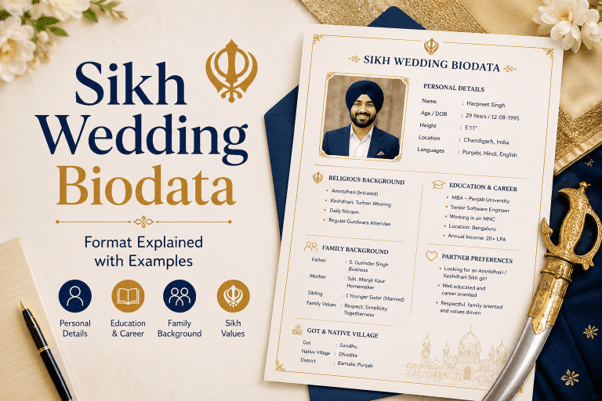
A Sikh wedding biodata is a one- or two-page marriage profile that introduces you and your family to potential matches. It typically includes your personal details, religious background, education, career, family information, and partner preferences in a clear, easy-to-read format.
When your family begins searching for a suitable Sikh marriage match, this biodata is often the first thing shared — whether through WhatsApp, relatives, Gurdwara connections, or matrimonial platforms. Before arranging meetings or lengthy conversations, families usually prefer to understand your background, values, and lifestyle through a well-structured profile.
What is a Sikh Wedding Biodata?
A Sikh wedding biodata is a structured marriage profile that introduces you and your family to prospective matches. It is usually the first document exchanged during the arranged marriage process through WhatsApp, relatives, Gurdwara communities, matrimonial websites, or marriage bureaus.
Unlike many other marriage biodatas, a Sikh biodata focuses on religious lifestyle, family values, education, career, and compatibility rather than astrological details like Kundli, Manglik, Rashi, or Nakshatra.
It typically includes your personal information, Amritdhari/Keshdhari/Sahajdhari status, Got, native village, family background, education, career, and partner preferences. The goal is to give both families a clear understanding of your background and lifestyle before moving ahead with a rishta.
How is a Sikh Marriage Biodata Different from Other Marriage Biodatas?
Although every arranged marriage biodata introduces a person, the information that families prioritise varies significantly across communities.
| Feature | Sikh Biodata | Hindu Biodata | Muslim Biodata |
|---|---|---|---|
| Primary Focus | Religious lifestyle, family values, education | Kundli, Manglik, Rashi along with family background | Religious practices, sect, family values |
| Religious Details | Amritdhari, Keshdhari, Nitnem, Gurdwara involvement | Temple traditions, astrology | Sunni/Shia, religious practices |
| Lineage Information | Got and Native Village | Gotra | Family lineage and surname |
| Marriage Ceremony | Anand Karaj | Hindu wedding rituals | Nikah |
| Partner Expectations | Lifestyle compatibility and family values | Astrology + preferences | Religious compatibility and family values |
This difference exists because Sikh marriages traditionally emphasise shared values, mutual respect, and commitment to the principles of Anand Karaj rather than horoscope matching. That is why many Sikh families carefully review religious practices and family background before they even discuss other details. Create Now!
What Should a Sikh Marriage Biodata Include?
Think of your biodata as a one-page introduction that answers the questions another Sikh family is most likely to ask before arranging the first meeting.
Every section should be concise, truthful, and easy to read.
1. Personal Details
This section establishes your basic identity. Families often use these details to verify compatibility in terms of age, location, and communication preferences.
Include:
- Full Name
- Date of Birth
- Age
- Height
- Weight (optional)
- Current City
- State
- Languages Known
- Contact Details (shared only if appropriate)
Example
- Name: Harpreet Singh
- Age: 29 Years
- Height: 5'11"
- Location: Chandigarh
- Languages: Punjabi, Hindi, English
Keep this section factual. Avoid adding unnecessary personal descriptions here.
2. Religious & Sikh Background
For many Sikh families, this is the first section they check.
Rather than making assumptions, your biodata should clearly explain your religious identity and lifestyle. Honest information prevents misunderstandings later in the process.
You may include:
- Amritdhari
- Keshdhari
- Sahajdhari
- Turban Wearing
- Nitnem Practice
- Gurdwara Attendance
- Vegetarian or Non-Vegetarian
- Participation in Sikh community activities
For example, an Amritdhari individual usually follows daily Nitnem and specific religious disciplines, while a Keshdhari Sikh maintains uncut hair as part of Sikh identity. Mentioning these details allows families to assess lifestyle compatibility instead of making assumptions based on appearance alone.
Being transparent here often saves both families considerable time.
3. Got, Native Village & Community
Although Sikhism teaches equality and rejects caste discrimination, many families still record Got and Native Village (Pind) to understand family lineage and avoid close ancestral relations.
This section commonly includes:
- Got
- Native Village
- District
- State
- Family Origin
Many traditional families verify this information early during the rishta process, especially when both families belong to similar regions.
Providing these details respectfully helps avoid unnecessary follow-up questions.
4. Education & Career
Education and career demonstrate your professional journey and financial stability. Families are generally looking for clarity rather than impressive wording.
Include:
- Highest Qualification
- College or University
- Occupation
- Company Name
- Designation
- Annual Income (Optional)
- Business Details (if self-employed)
Instead of writing lengthy descriptions, mention your current professional position clearly.
For example:
- MBA – Panjab University
- Senior Software Engineer
- Bengaluru
- Working in an MNC
Simple, accurate information builds more trust than exaggerated achievements.
5. Family Background
Marriage is often viewed as the coming together of two families rather than only two individuals.
This section should introduce your family's values and background without sounding like a financial statement.
Include:
- Father's Name & Occupation
- Mother's Name & Occupation
- Number of Siblings
- Married or Unmarried Siblings
- Family Business or Profession
- Family Values
Instead of emphasising wealth, highlight qualities such as education, respect, community involvement, and supportive relationships.
6. Partner Preferences
Partner expectations help avoid mismatched conversations later.
Be realistic, respectful, and honest.
You may mention preferences regarding:
- Age
- Height
- Education
- Profession
- Religious Lifestyle
- Preferred Location
- Family Values
- Willingness to Relocate
Avoid creating an unrealistic checklist. Clear expectations encourage meaningful conversations instead of eliminating suitable matches unnecessarily.
Also Read: Best Biodata Format for Hindu Marriage Profiles
Sikh Wedding Biodata Examples
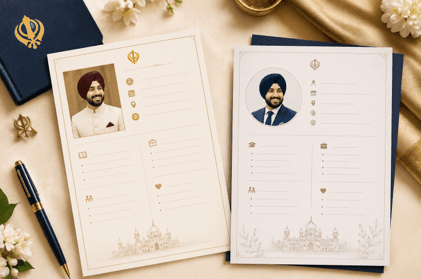
Real examples make it easier to understand how a Sikh biodata should look.
Example 1: Traditional Sikh Biodata
Profile
- 30-year-old Keshdhari Sikh
- Turban wearer
- Regular Nitnem
- Based in Ludhiana
- Master's Degree in Commerce
- Family engaged in agriculture and business
- Looking for a Sikh bride who values family traditions and wishes to participate in Anand Karaj according to Sikh customs.
Example 2: Modern Urban Sikh Biodata
Profile
- 28-year-old software professional
- Lives in Bengaluru
- B.Tech graduate
- Speaks Punjabi, Hindi, and English
- Regular Gurdwara visitor
- Family settled in Delhi
- Looking for an educated professional who respects Sikh values while pursuing a modern career.
Example 3: NRI Sikh Biodata
Profile
- 31-year-old Mechanical Engineer
- Permanent Resident in Canada
- Punjabi family originally from Jalandhar
- Master's Degree
- Visits India regularly
- Looking for a compatible Sikh partner open to settling abroad while maintaining strong Punjabi family traditions.
These examples show that the format remains similar, but the information changes depending on lifestyle and personal circumstances. Create Today!
Sikh Marriage Biodata Formats You Can Choose
Different families prefer different presentation styles. Choosing the right format improves readability and creates a better first impression.
| Biodata Format | Best For |
|---|---|
| Traditional Punjabi Format | Traditional Sikh families |
| Modern Professional Format | Urban professionals |
| Bilingual Punjabi-English Format | UK, Canada, USA, Australia families |
| Amritdhari Biodata Format | Families prioritising religious lifestyle |
| Simple One-Page Biodata | WhatsApp sharing and quick introductions |
Choose a format that reflects your personality while remaining easy to read. Fancy graphics rarely matter as much as clear organisation.
Common Mistakes That Reduce Marriage Responses
Many excellent profiles receive fewer responses because of avoidable presentation mistakes rather than compatibility issues.
Common mistakes include:
- Writing long paragraphs instead of concise sections
- Using blurry or outdated photographs
- Leaving out religious details
- Forgetting to mention Got or Native Village when your family expects it
- Not including partner preferences
- Spelling and grammar mistakes
- Inconsistent formatting
- Sharing editable Word documents instead of PDF files
One overlooked issue is mobile readability. Since many parents review biodatas on WhatsApp, poor formatting or tiny fonts can make an otherwise strong profile difficult to read.
Tips to Make Your Sikh Biodata Stand Out
A professional biodata does not need elaborate graphics. It needs clarity, honesty, and thoughtful organisation.
Follow these practical tips:
- Keep the biodata within one or two pages.
- Use professional fonts with consistent spacing.
- Mention your religious practices honestly.
- Include a recent, high-quality photograph.
- Avoid exaggerated achievements.
- Write partner expectations respectfully.
- Export the final version as a PDF to preserve formatting.
- Review spelling and grammar before sharing.
A clean, readable document reflects attention to detail and respect for the family receiving it.
Free Sikh Marriage Biodata Templates
Creating a Sikh marriage biodata from scratch in Word or using a generic template can be time-consuming. Most standard templates don't include important Sikh-specific fields like Amritdhari status, Got, Native Village, or Religious Practices.
With our platform, BiodataPlus, you can simply choose a ready-made Sikh biodata template and customise it in minutes.
You can create:
- Sikh marriage biodata templates
- Punjabi marriage biodata formats
- Amritdhari biodata templates
- Bilingual Punjabi-English biodatas
- WhatsApp-friendly designs
- Professional PDF downloads
- 17 free templates
This helps you create a well-structured, professional biodata without spending hours on formatting.
Why Many Sikh Families Prefer BiodataPlus
Many online biodata builders are designed as generic resume creators. As a result, they often miss important cultural details that matter during Sikh matchmaking.
At BiodataPlus, we built our templates around the real information Sikh families commonly look for.
Our templates include:
- Dedicated Amritdhari, Keshdhari, and Sahajdhari fields
- Got and Native Village sections
- Religious lifestyle details
- Family background layouts
- Partner preference sections
- Bilingual support
- Modern and traditional designs
- Mobile-friendly PDF exports
- Free Sikh biodata templates
Rather than adapting a generic design, you can create a biodata that feels complete, culturally relevant, and ready to share with confidence.
Conclusion
A Sikh wedding biodata is most effective when it includes the right community-specific fields — gotra or family lineage, native village, and Amritdhari status — alongside the standard personal and career details. Keep the format clean, the photo professional, and the partner expectations realistic. Browse Sikh marriage biodata templates designed specifically for Punjabi families, or explore the full community biodata page for all religions and backgrounds.
Also Read: Muslim Marriage Biodata Format: What to Include and Avoid