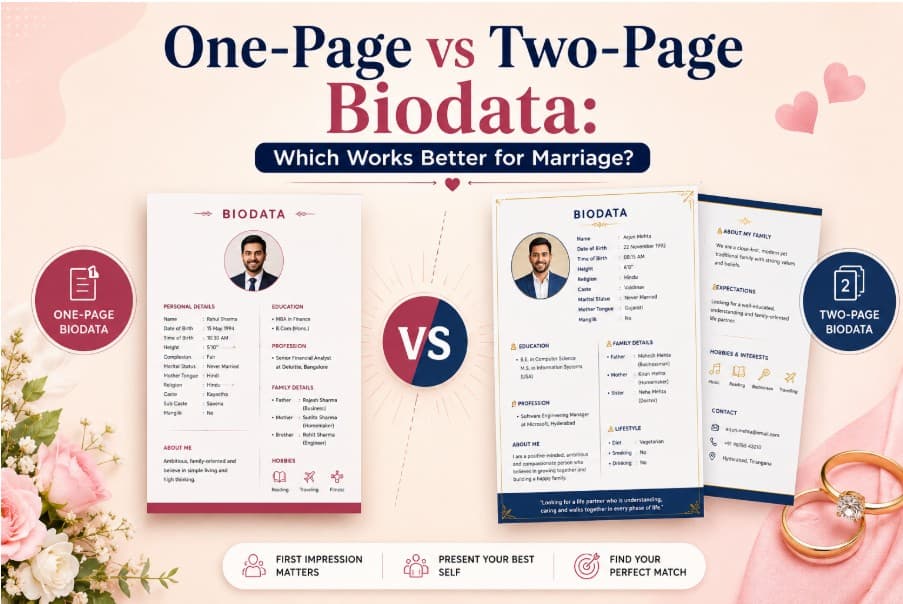
A one-page biodata is best for simplicity and quick introductions, while a two-page biodata is better for sharing more detailed information and building family confidence.
If you're confused about which option to choose, you're not alone. Many people worry that a one-page biodata may feel too brief, while a two-page biodata may feel too long. The good news is that both formats can work well when they are structured properly.
The real difference isn't which one is better overall. It's about what you need your biodata to achieve. A one-page format is designed to grab attention and make a strong first impression, while a two-page format focuses on building trust by providing greater depth and transparency.
Why Biodata Length Matters More Than Most People Realize
Most families don't read every biodata from start to finish — they scan first and decide later.
Whether your biodata is one page or two pages, the way it presents information affects that first impression. A cluttered profile can feel overwhelming, while a profile with too little information can leave families with unanswered questions.
The most effective biodata strikes a balance between clarity and detail. You want readers to feel informed, interested, and confident enough to keep reading — and that often matters more than the actual page count. Create your biodata now
Understanding the Psychology Behind Biodata Reading
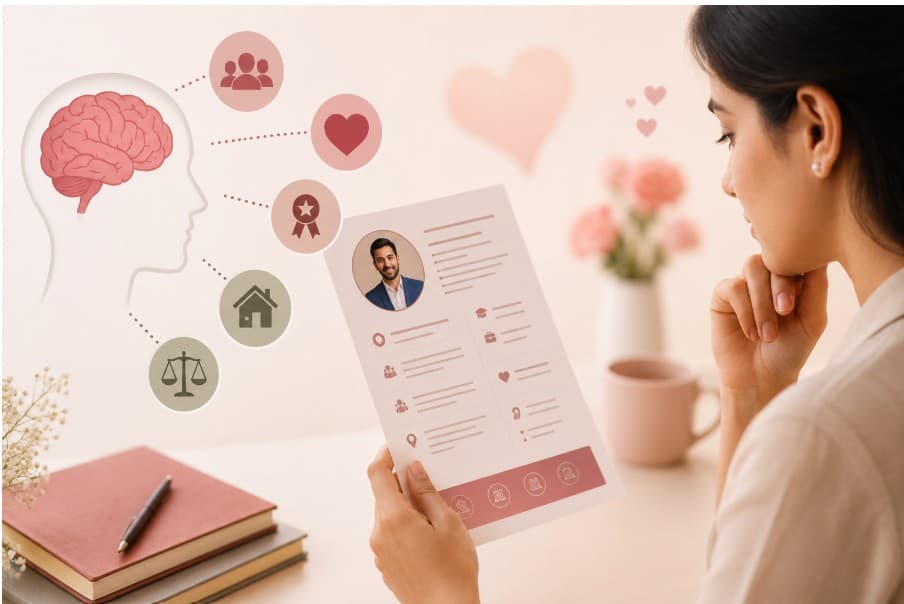
Before comparing formats, it helps to understand how people consume information.
Most biodatas today are viewed on mobile devices. Families often open a PDF directly from WhatsApp and spend only a few moments deciding whether they want to continue reading.
This creates what can be called a "first-screen impression."
If essential information such as age, education, profession, location, and photograph is immediately visible, readers are more likely to continue.
If they need to zoom, scroll excessively, or search for key details, attention drops quickly.
This is why readability, layout, and information hierarchy often influence responses more than biodata length itself. Try it now
What Is a One-Page Biodata?
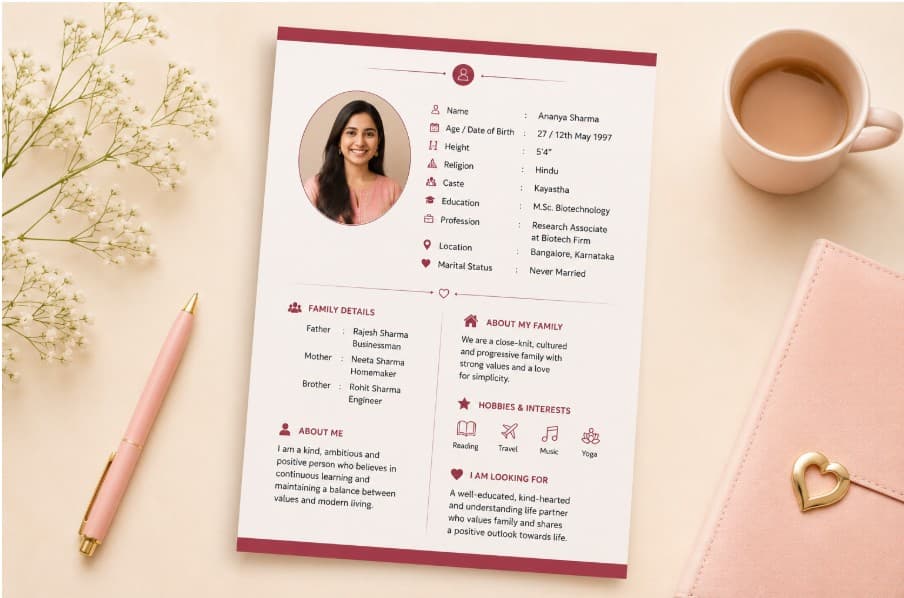
A one-page biodata focuses on presenting the most important information in a concise and organized manner.
It is commonly used in modern matchmaking because it is easy to view, easy to share, and easy to understand.
Typical Sections Included
A simple biodata usually contains the following core sections:
- Personal Information: Name, date of birth, age, height, and other basic details.
- Education & Career: Educational qualifications, profession, workplace, and career highlights.
- Family Overview: Brief information about parents, siblings, and family background.
- Contact Details: Phone number, email address, or family contact information.
- Photograph: A recent, professional-looking photo.
The goal is not to include everything.
The goal is to include everything necessary.
Benefits of a One-Page Biodata
A concise biodata offers several practical advantages:
- Easy to read from beginning to end
- Creates a clean and professional appearance
- Works exceptionally well on mobile devices
- Convenient for WhatsApp sharing
- Faster for families to evaluate
- Makes a strong first impression
One-page formats also align with modern reading habits. Since people naturally prefer information that requires less effort to process, shorter profiles often achieve higher completion rates.
Best Situations for Using a One-Page Biodata
A one-page biodata works particularly well if you are:
- A young professional
- Sharing profiles digitally
- Introducing yourself for the first time
- Participating in modern matchmaking processes
- Looking for a minimalist biodata design
For many initial conversations, a single page provides enough information to determine basic compatibility. Try now
What Is a Two-Page Biodata?
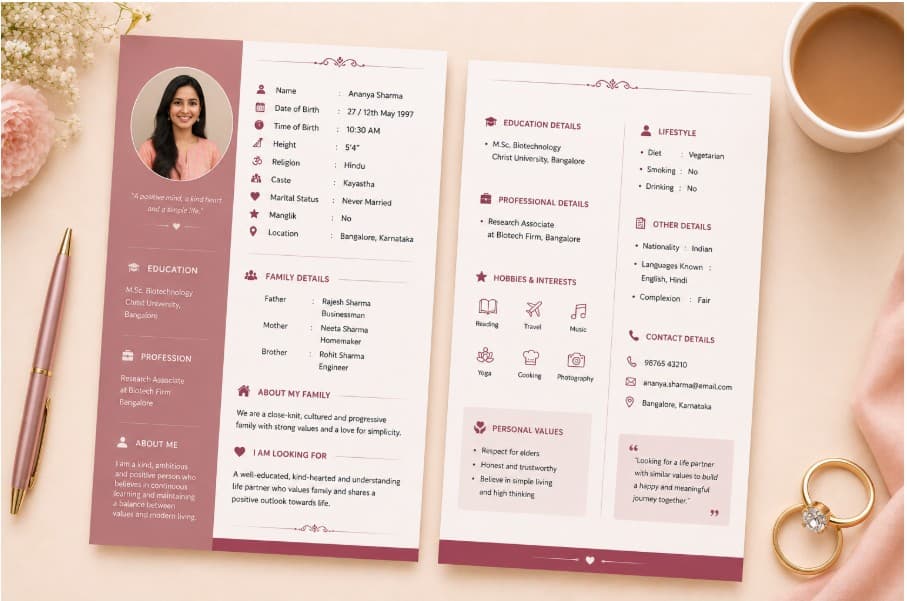
A two-page biodata expands beyond core details and provides a more complete picture of your background, family, and expectations.
This format is often preferred in traditional matchmaking environments where families seek deeper understanding before moving forward.
Additional Information Commonly Included
Beyond the standard details, a detailed biodata may include:
- Extended family information
- Sibling details
- Family occupations
- Lifestyle preferences
- Personal interests and hobbies
- Partner expectations
- Career achievements
- Community-specific information
- Additional photographs
Rather than creating curiosity, a two-page profile focuses on reducing uncertainty.
Benefits of a Two-Page Biodata
A detailed biodata profile offers advantages that many families appreciate:
- Greater transparency
- Better family understanding
- Fewer follow-up questions
- Stronger trust signals
- More room for personalization
- Better compatibility filtering
When families value detailed discussions and comprehensive evaluation, a two-page format often feels more reassuring.
Best Situations for Using a Two-Page Biodata
A two-page biodata is often ideal for:
- Traditional families
- Community-based matchmaking
- Family-led discussions
- Detailed compatibility evaluation
- Premium biodata presentations
If extensive family information plays a major role in decision-making, additional space can be beneficial. Discover Muslim marriage biodata and Hindu marriage biodata format.
One-Page vs Two-Page Biodata: Side-by-Side Comparison
| Factor | One-Page Biodata | Two-Page Biodata |
|---|---|---|
| Readability | Excellent | Good |
| Detail Level | Moderate | High |
| Mobile Friendliness | Excellent | Moderate |
| First Impression Speed | Very Fast | Moderate |
| Traditional Appeal | Moderate | Strong |
| Modern Appeal | Strong | Moderate |
| Follow-Up Questions | More Likely | Less Likely |
| WhatsApp Sharing | Ideal | Good |
| Family Transparency | Moderate | High |
| Best Use Case | Initial Introductions | Detailed Discussions |
The Attention Factor: Why One-Page Biodatas Often Get Viewed Completely
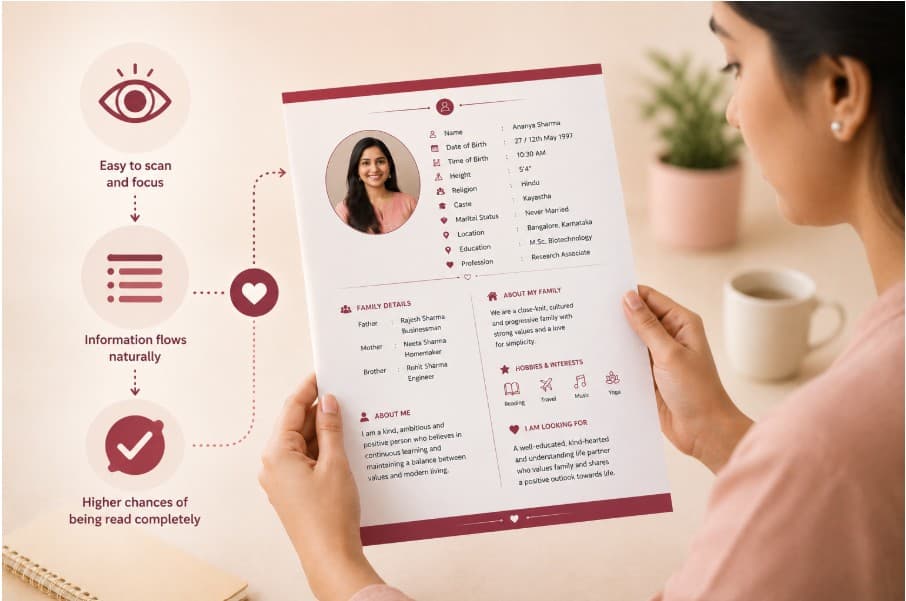
People naturally prefer information that is quick and easy to understand.
When families see a clean one-page biodata, they can quickly find the details they care about without feeling overwhelmed. Because there is less to read, they are also more likely to go through the entire profile.
In many cases, families form their initial opinion within the first few moments of viewing a biodata. That's why a clear and well-organized layout can be just as important as the information itself. Use the free marriage biodata maker.
The Trust Factor: Why Two-Page Biodatas Feel More Transparent
Trust is often built through information.
When readers see detailed family backgrounds, expectations, achievements, and lifestyle information, they feel they have a fuller picture of the individual behind the biodata.
This does not automatically make a two-page profile better.
However, it can make readers feel more confident that important details are being shared openly.
For families that value transparency above speed, this can be a significant advantage. Create today
The Curiosity Factor: Less Information Can Sometimes Create More Interest
An overlooked benefit of concise biodatas is strategic curiosity.
A one-page profile naturally leaves room for conversation.
Instead of answering every question immediately, it encourages families to reach out, ask questions, and start meaningful discussions.
This can create stronger engagement during early stages of matchmaking. The key is ensuring that essential information is still present.
Curiosity should never become confusion.
Also Read: About Me for Marriage Biodata — 50 Examples
Common Mistakes When Choosing Biodata Length
Many people focus so much on page count that they overlook more important factors.
Avoid these common biodata mistakes:
Trying to Fit Everything on One Page
Shrinking fonts, reducing spacing, and overcrowding sections may technically keep your biodata to one page, but it damages readability.
A crowded one-page biodata often performs worse than a clean two-page version.
Creating a Weak Second Page
A second page should add value.
If page two contains only a few extra lines, readers may feel the information could have been organized more effectively.
Prioritizing Length Over Design
Good biodata design is more important than page count.
Proper spacing, clear headings, consistent formatting, and visual balance have a greater impact on user experience.
Best Biodata Structure for Maximum Responses
Regardless of length, the highest-performing marriage biodata formats usually follow a similar structure:
- Personal information
- Professional photograph
- Education details
- Career information
- Family background
- Lifestyle information
- Expectations (if applicable)
- Contact details
Always place the most important information first.
Remember, readers may not reach the bottom if they cannot quickly find what they need at the top. Get started now
When Should You Choose a One-Page Biodata?
A one-page biodata is often the smarter choice when:
- You are sharing through WhatsApp
- You want quick initial responses
- You have limited information to present
- You prefer a modern biodata style
- You want maximum readability
Think of it as your introduction profile. Its purpose is to generate interest and encourage conversation. Make biodata online
When Should You Choose a Two-Page Biodata?
A two-page biodata becomes valuable when:
- Families request detailed information
- Family background requires explanation
- Expectations need clarification
- Traditional matchmaking is involved
- You want a premium biodata presentation
Think of it as your complete profile. Its purpose is to answer questions before they are asked.
Expert Recommendation: Focus on Clarity, Not Page Count
The best biodata is not determined by page count but by how clearly it communicates the right information.
If simplicity is your priority, use one page.
If depth is your priority, use two pages.
In fact, many successful candidates keep both versions ready. A concise one-page biodata works perfectly for initial WhatsApp introductions, while a detailed two-page version can be shared once mutual interest develops.
This approach combines the strengths of both formats. Create attractive biodata
What Should You Avoid Adding to a Biodata?
Avoid including:
- Excessively personal information such as Aadhaar numbers, bank details, passport numbers, or other sensitive data.
- Long life stories or lengthy descriptions that make the biodata difficult to scan.
- Too many photographs, as they can make the layout look crowded and unprofessional.
- Unverified achievements or exaggerated claims, which can damage trust if discussed later.
- Irrelevant details that do not help families understand your background, values, education, profession, or family situation.
Remember, the purpose of a biodata is to provide clear and relevant information — not to document every aspect of your life. Keeping it focused makes it easier to read and creates a stronger impression.
Create Both Formats Easily with BiodataPlus
Once you understand the strengths of each format, the next challenge is creating them professionally.
At BiodataPlus, we built our platform around a simple idea: every person deserves a biodata that reflects their unique background, preferences, and family requirements.
Whether you need a minimalist one-page biodata, a traditional two-page profile, or a premium marriage biodata design, our platform helps you create it without dealing with complicated formatting or design software.
Why Users Prefer BiodataPlus
- Create both one-page and two-page biodatas from the same information
- Free biodata templates for quick starts
- Richer designs for a more polished presentation
- Modern, traditional, and professional layouts
- Customizable sections and formatting
- Mobile-friendly biodata creation process
- Flexible photo placement options
- Easy editing and updates anytime
- Suitable for all religions, castes, genders, communities, and unique family situations
Thousands of users trust our platform because it simplifies what can otherwise become a time-consuming process.
Instead of worrying about formatting, spacing, and design, you can focus on presenting yourself authentically and professionally. Learn more
Also Read: Marriage Biodata Photo Guide — Tips for the Perfect Photo
Final Thoughts
Ultimately, the best biodata isn't the one with more pages — it's the one that presents your information clearly and professionally.
Whether you choose a one-page or two-page format, BiodataPlus helps you create both with free templates designed for different preferences, communities, and family requirements. Choose the format that fits your situation best and represents you with confidence.