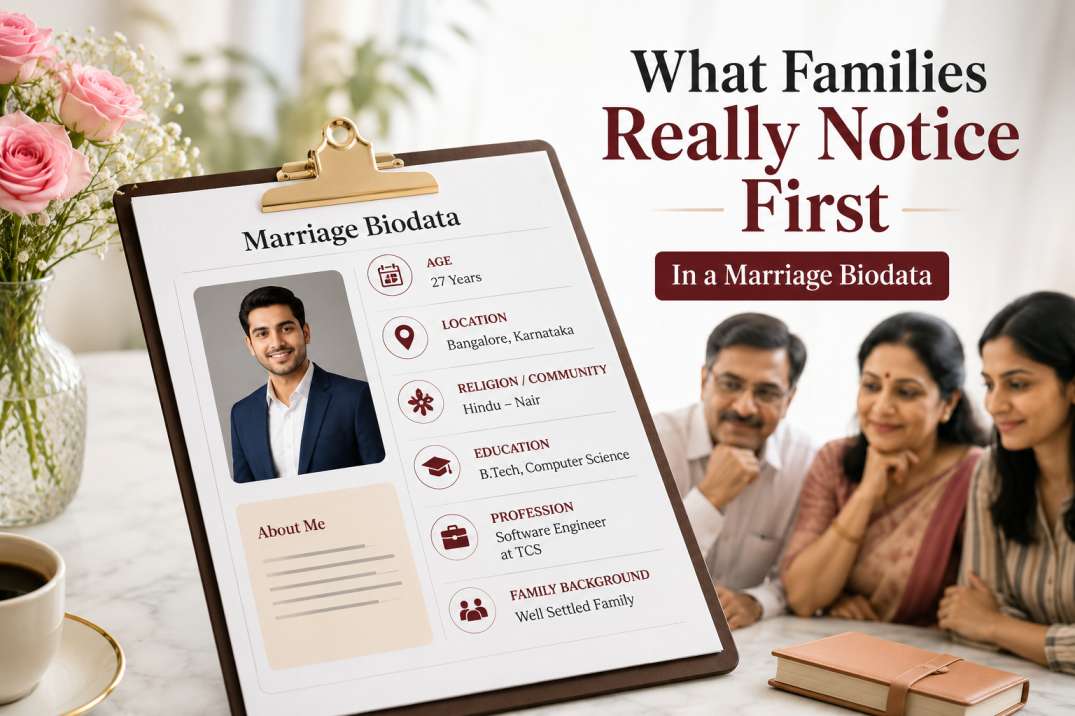
Families usually notice your age, current location, religion or community, photograph, education, profession, and family background first when they look at a marriage biodata. These details act as their initial filters before they spend time reading your personal description, hobbies, or other information.
The psychology behind this is simple. Most families review multiple biodatas shared through WhatsApp, email, or matrimonial platforms, so they naturally look for the most important information first instead of reading every word. Their eyes search for details like your age, location, education, profession, family background, and photograph before they pay attention to personal descriptions.
If these details are easy to find and presented clearly, your biodata becomes easier to shortlist.
Families Don't Read a Marriage Biodata — They Scan It
Before reading your biodata in detail, most families look for answers to a few practical questions first. If they find those answers quickly, they're more likely to continue reading.
This happens because the brain naturally looks for familiar information first to make quick decisions. Personal qualities, hobbies, and your "About Me" section become more meaningful only after these basic compatibility checks are satisfied.
The First 7 Things Families Notice in a Marriage Biodata
1. Age — The First Filter Before Anything Else
Age is often the very first number families look for. Whether they are searching for a younger or older match, age helps them quickly determine if the profile fits their preferred range.
Even before reading your education or career details, many families mentally compare your age with their expectations. If there is a significant difference from what they are looking for, they may not continue reading the rest of the biodata — not because other qualities aren't valuable, but because the primary filter has already been applied.
Instead of hiding age inside a paragraph, place it prominently alongside your name and basic details. Browse marriage biodata templates →
Quick Action: Make your age easy to find within the top section of your biodata.
2. Location & Native Place — Can This Marriage Actually Work?
Location immediately triggers practical thinking.
Families aren't only asking where you live today — they're imagining how easily the relationship can work. They may already be considering travel distance, relocation possibilities, family visits, and future living arrangements.
For example, writing only "Delhi" leaves many questions unanswered. A more useful approach is to mention your current area along with your native place.
| Less Helpful | More Helpful |
|---|---|
| Delhi | Dilshad Garden, Delhi (Originally from Jaipur) |
| Mumbai | Navi Mumbai (Native Place: Nagpur) |
These small details help families understand your background without needing additional clarification.
Remember that location isn't about creating restrictions. Different families have different preferences, and providing complete information simply makes evaluation easier.
Quick Action: Mention both your current location and native place near the beginning of your biodata.
3. Religion, Community & Cultural Background — Shared Values Matter
Every family approaches marriage differently.
Some families are completely open to different communities, while others prefer matches within a particular religion, caste, sub-caste, or gotra where applicable. These preferences often reflect cultural traditions rather than judgments about individuals.
Providing these details clearly helps avoid unnecessary confusion later. It also allows families who share similar cultural expectations to understand your background quickly.
You don't need lengthy explanations. A simple, accurate mention is usually enough.
Include details such as:
- Religion
- Community or caste (where relevant)
- Sub-caste (if applicable)
- Gotra (when traditionally important)
For community-specific biodata formats — with the right fields for your religion and background — browse templates by community: Hindu, Muslim, Sikh, Jain, Christian, Tamil, Marathi, or Buddhist.
Quick Action: Share cultural information honestly without making it the dominant part of your biodata.
4. Photograph — Before Reading, People Look at the Face
People naturally notice photographs before reading text. This isn't unique to marriage biodatas — it's simply how human attention works.
A clear, recent photograph creates trust much faster than an overly edited or heavily filtered image. Families aren't expecting a professional fashion shoot. They're simply looking for authenticity.
A good marriage biodata photo usually has:
- A recent picture that reflects your current appearance
- Natural lighting
- A simple background
- Neat and appropriate attire
- A genuine smile or pleasant expression
Avoid excessive filters, dramatic editing, or distracting backgrounds. These often create unnecessary doubts instead of making a stronger impression.
A clear photograph builds confidence faster than a glamorous one. For a complete guide on photo selection, see the marriage biodata photo guide.
Quick Action: Choose authenticity over perfection.
5. Education & Profession — Stability Speaks Loudly
Education and career tell families much more than academic qualifications alone.
They help people understand your professional journey, financial stability, career growth, and long-term goals. Parents often see these details as indicators of responsibility and future planning rather than simply income.
Instead of writing only your degree, provide enough context to make your career easy to understand:
- Highest educational qualification
- Current profession
- Company or business name (if comfortable sharing)
- Industry
- Career achievements or specialization
A well-structured presentation helps families understand your professional life without lengthy explanations.
Quick Action: Keep your education and profession concise, factual, and easy to scan.
6. Family Background — Who Raised This Person?
This section often influences conversations more than many people realise.
Families are not only evaluating you as an individual. They are also trying to understand the environment that shaped your values, upbringing, and lifestyle.
Include relevant information such as:
- Parents' names and occupations
- Number of siblings
- Siblings' occupations or education
- Family values and background
- Whether yours is a joint or nuclear family (if relevant)
Keep this section respectful and balanced. You don't need to oversell your family — simply present accurate information that gives readers a clear picture.
Quick Action: Think of family details as context, not as a list of achievements.
7. Lifestyle & Personal Information — The Compatibility Check
Lifestyle details rarely determine the first shortlist, but they often become important once families begin comparing suitable profiles.
These details help answer everyday compatibility questions. Consider including:
- Food preference
- Languages spoken
- Hobbies and interests
- Smoking or drinking habits (if applicable)
- Fitness or wellness interests
- Personal values or lifestyle preferences
Avoid turning this into a long autobiography. Instead, focus on information that helps another family understand how your daily life looks.
Quick Action: Share enough to reflect your personality without overwhelming readers.
The Biggest Mistakes People Make in Their Marriage Biodata

Sometimes an excellent profile gets overlooked simply because the information isn't presented well.
The most common mistakes include:
- Writing long paragraphs instead of structured sections
- Hiding important details inside descriptive text
- Using blurry or outdated photographs
- Adding excessive colours, graphics, or decorative elements that reduce readability
- Leaving out family information completely
- Using inconsistent formatting that looks confusing on mobile devices
- Forgetting contact details or making them difficult to locate
Many families now review biodatas directly on WhatsApp. If they have to zoom repeatedly or search for essential information, they may simply move to another profile.
Practical takeaway: A biodata should reduce effort for the reader, not create more of it.
What Makes a Marriage Biodata Easy to Shortlist?
A successful marriage biodata isn't necessarily the most attractive-looking one. It's the one that helps families find the information they need quickly.
The strongest biodatas usually share these characteristics:
| Feature | Why It Matters |
|---|---|
| Clean layout | Makes information easy to scan |
| Clear headings | Helps readers locate details instantly |
| Readable fonts | Improves mobile and print readability |
| Balanced information | Prevents important details from being overlooked |
| Professional appearance | Builds confidence and trust |
| Logical structure | Matches how families naturally review biodatas |
When information is well organised, families spend more time understanding your profile instead of searching for basic details.
Every Family Has a Different Shortlisting Order
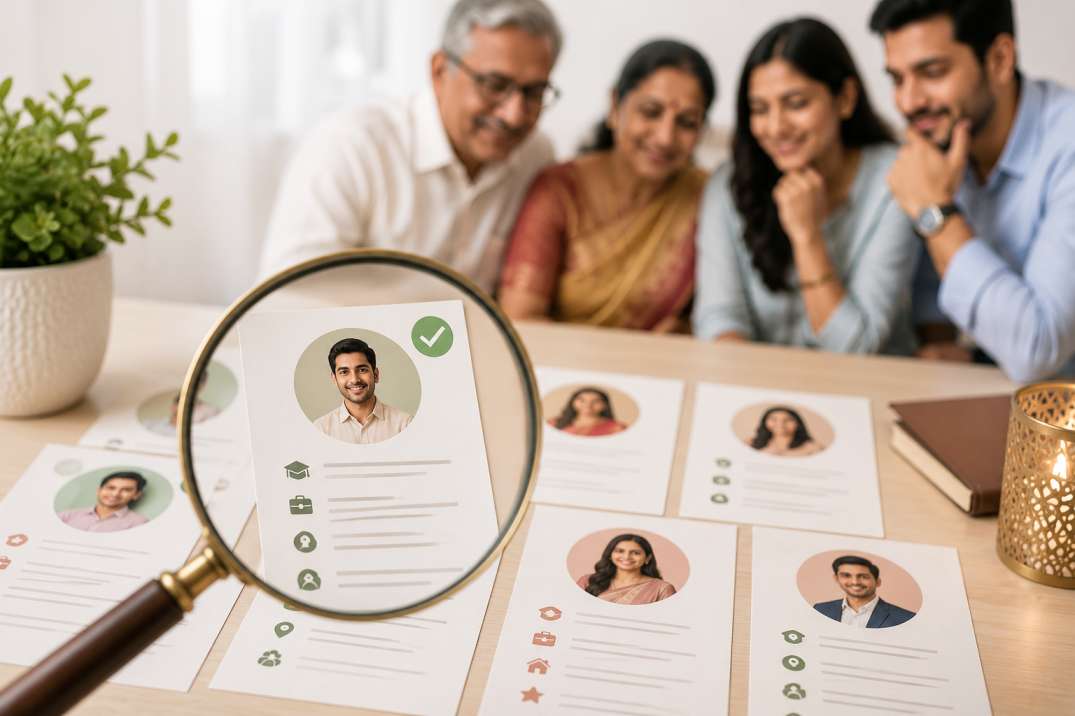
There isn't a universal checklist that every family follows. While most people scan a marriage biodata instead of reading it line by line, the order of importance varies from one family to another, depending on their priorities, culture, and expectations.
For example:
| Family's Priority | What They May Notice First |
|---|---|
| Location-focused families | Current city and native place |
| Traditional families | Religion, community, or cultural background |
| Career-oriented families | Education and profession |
| Families prioritising compatibility | Lifestyle, values, and personal interests |
| Families with a preferred age range | Age and height |
This is why you shouldn't hide any important information or place it deep inside long paragraphs. A family that considers education their top priority shouldn't have to search for it, just as another family shouldn't struggle to find your location or community details.
Quick Checklist Before Sending Your Marriage Biodata
Before sharing your biodata with anyone, review this checklist:
- ✓ Recent photograph
- ✓ Full name
- ✓ Age
- ✓ Height
- ✓ Current location
- ✓ Native place
- ✓ Religion and community (where applicable)
- ✓ Education
- ✓ Profession
- ✓ Family details
- ✓ Lifestyle information
- ✓ Contact details
- ✓ Proofread for spelling and formatting
This simple review can prevent avoidable mistakes that often affect first impressions.
Conclusion
Your marriage biodata doesn't need to impress families with long descriptions — it needs to help them find the right information quickly. A clear structure, complete details, and a professional layout can make a strong first impression before a single conversation begins.
That's where BiodataPlus comes in. Our platform helps you create professionally designed marriage biodatas with free templates for all castes and religions — Hindu, Muslim, Sikh, Christian, Jain, Tamil, Marathi, and more. Simply enter your details, customise your preferred design, and download a high-quality PDF that's ready to share.
Also Read: